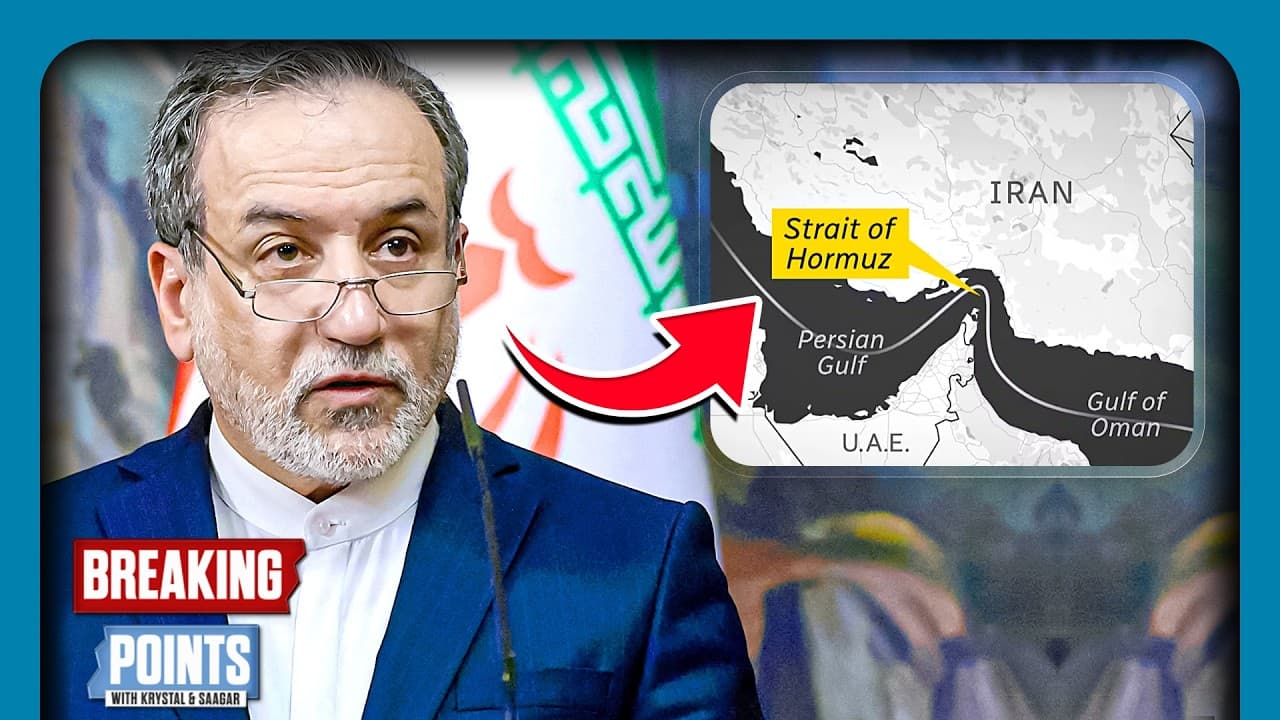
Iran Closes Strait of Hormuz: Ceasefire Violation Fallout

Key Takeaways
- •Iran closed the Strait of Hormuz after Israel escalated military operations in Lebanon — a region Iran says was explicitly included in the ceasefire terms.
- •The Financial Times reports the Trump administration was secretly seeking a ceasefire while publicly claiming Iran was the one begging for a deal.
- •Netanyahu publicly rejected any ceasefire in Lebanon and pledged to continue strikes on Hezbollah, directly undermining the diplomatic framework.
Iran Closes Strait of Hormuz in Response to Israeli Escalation
The Strait of Hormuz is closed. Iran made that call after Israel continued military operations in Lebanon — which, according to Iranian officials, was a named part of the original ceasefire agreement. Trump posted about it on social media, expressing frustration. In their video Trump TRASHES 'LOW IQ' Tucker, Candace, Megyn, the hosts at Breaking Points were less than sympathetic to that framing, pointing out that Iran's move was a direct consequence of "a deal that appears to have been broken before the ink dried."
Netanyahu's Public Rejection of Lebanon Ceasefire
Benjamin Netanyahu did not leave much room for interpretation. He stated publicly that there is no ceasefire in Lebanon and that Israel would continue striking Hezbollah. That declaration didn't just complicate the diplomatic picture — it blew a hole through it. If Lebanon was part of the agreed terms, and Israel's own prime minister is on record saying the war there continues, then the ceasefire was functionally over the moment he spoke.
US Secretly Negotiated Ceasefire While Publicly Denying It
The Financial Times reported that the Trump administration had been working to secure a ceasefire for weeks. The problem: the administration's public position was that Iran was the desperate party, the one coming to the table with its hat in hand. Both things cannot be true. The gap between what was being said publicly and what was happening in private diplomatic channels is not a minor inconsistency — it's the kind of contradiction that makes future negotiations nearly impossible to conduct in good faith.
Iran's Strategic Leverage Through Strait of Hormuz Control
Closing the Strait of Hormuz is not a symbolic gesture. Roughly 20 percent of the world's oil passes through it. Breaking Points frames Iran's control of that chokepoint as functionally equivalent to a nuclear deterrent — not because of the destruction it causes, but because of the cost any military response would impose on whoever tries to reopen it by force. The US could attempt it, but the economic and military price tag would be extraordinary, and Iran knows that.
Why Iran Views US Diplomatic Efforts With Skepticism
Iran's leadership, particularly the IRGC, is operating from a specific historical memory: diplomacy has been used before as cover for military preparation. Their working assumption, according to Breaking Points, is that current US outreach is a setup rather than a sincere offer. Iran has put forward its own 10-point plan and says it's willing to talk — but on that basis, not on terms that require trusting an administration that was publicly lying about who wanted the ceasefire in the first place. That level of institutional distrust doesn't dissolve because someone sends a polite letter.
The Collapse of Middle East Ceasefire Negotiations
What's collapsed here isn't just a single agreement. It's the scaffolding that would make any near-term agreement possible. You have Israel's prime minister publicly rejecting the terms, the US caught misrepresenting its own negotiating position, and Iran responding by pulling the one lever that causes immediate, global economic pain. The conditions for a durable deal — some baseline of shared understanding about what was agreed and by whom — don't currently exist. As we explored in our look at bipartisan frustration over US-Israel aid policy, the disconnect between Washington's public statements and its actual diplomatic posture has been building for a while.
Implications for Global Oil Markets and Shipping Routes
A closed Strait of Hormuz is an immediate problem for global energy markets. The passage handles a significant share of seaborne oil exports from Saudi Arabia, the UAE, Kuwait, and Iraq — not just Iran. Any prolonged closure drives up oil prices globally, which feeds into inflation, shipping costs, and the kind of economic pressure that tends to accelerate political decisions. The leverage Iran holds here is not theoretical. It is priced into every barrel of oil the moment the closure is confirmed.
What Happens Next in US-Iran Relations
The honest answer is that the pathway to de-escalation is narrow and getting narrower. Iran has stated its conditions. Israel has publicly rejected the ceasefire framework. The US has been caught contradicting its own public statements. None of those three positions are easy to walk back without someone losing face in a very visible way. The question of whether any party has the political will to absorb that cost — and who moves first — is what the next phase of this actually turns on. Given the broader pattern of congressional debate over military aid to Israel, domestic political pressure in the US is unlikely to push the administration toward a softer line anytime soon.
Our Analysis: The detail that stings most here is the Financial Times reporting. The Trump administration spent weeks telling the public that Iran was desperate for a deal — while privately being the ones pushing for one. That's not spin. That's a deliberate inversion of the actual negotiating dynamic, and it matters because Iran's leadership read the same reports. You cannot simultaneously lie about who needs the ceasefire more and then expect the other side to trust the terms you're offering.
Netanyahu's public statement is doing a lot of quiet damage that isn't getting enough attention. He didn't hedge. He didn't leave room for diplomatic interpretation. He said there is no ceasefire in Lebanon — which means either the US didn't secure what it claimed, or it secured something Israel had no intention of honoring. Either way, the next round of talks starts from a worse position than the last one did. That's not a recoverable gap through better messaging.
Frequently Asked Questions
Did Iran close the Strait of Hormuz over the ceasefire breakdown?
What would actually happen if Iran closes the Strait of Hormuz for an extended period?
Why did Iran accept the ceasefire if it didn't trust the US or Israel to honor it?
Why does Iran think US diplomatic outreach is a setup rather than a real peace offer?
How did the US get caught misrepresenting its own ceasefire negotiations with Iran?
Based on viewer questions and search trends. These answers reflect our editorial analysis. We may be wrong.
Source: Based on a video by Breaking Points — Watch original video
This article was created by NoTime2Watch's editorial team using AI-assisted research. All content includes substantial original analysis and is reviewed for accuracy before publication.
Related Articles



You Might Also Like
Apr 2
World News | US intelligence failure Iran policy: Ex-CIA on Misconceptions
Apr 14
World News | Gas Prices Iran Blockade Oil Shortage: $6/Gallon Risk
Apr 11
Life Stories | Ivanka Trump White House Accomplishments: A Detailed Look

Apr 7
World News | Iran Strait of Hormuz oil control: Global Economy Impact