Kuwait Airport Drone Attack Ignites Fuel Tanks
Key Takeaways
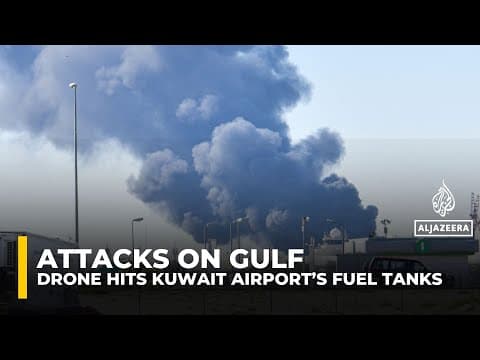
- •Kuwait's international airport suffered a major fire after a drone strike targeted its fuel storage tanks, with Kuwaiti aviation authorities blaming Iranian-backed factions believed to be operating from inside Iraq.
- •Reported by Al Jazeera English in the video "'Large fire' at Kuwait airport after 'brazen attack' on fuel tanks," the incident marks the seventh such attack on the airport since hostilities began.
- •Strong winds are hampering emergency response efforts.
Kuwait Airport Drone Attack Hits Fuel Storage
A drone strike on Kuwait International Airport ignited a large fire in its fuel tank storage area, according to Al Jazeera English's recent video 'Large fire' at Kuwait airport after 'brazen attack' on fuel tanks. There were no initial reports of casualties, but the damage to fuel infrastructure was described as extensive. The attack was brazen in its targeting: fuel storage is not an accidental choice. It is the kind of target designed to ground planes, disrupt supply chains, and make a statement at the same time.
The Seventh Time Is Not a Coincidence
This was not a one-off incident. The Kuwait airport drone attack is the seventh assault on the facility since the current round of hostilities began. That number matters. Seven attacks on a single piece of critical infrastructure is a pattern, not an escalation. It is a sustained campaign. A previous strike on the same airport took emergency responders more than 58 hours to fully extinguish, which gives some sense of what the current teams are walking into. If you have been following how drone warfare is being used to Our Analysis: Seven attacks on Kuwaiti infrastructure since the conflict began is not a pattern of escalation. It is a sustained campaign with a clear objective: making Gulf energy infrastructure feel permanently at risk. The debate between military pressure and diplomacy misses what is actually happening on the ground. Drone strikes on fuel depots are cheap, deniable, and keep working even when negotiations are supposedly underway. Any diplomatic framework that does not account for that operational reality will not hold. What deserves more attention is the cumulative economic logic of this campaign. A single strike on a fuel storage facility is a news event. Seven strikes on the same facility is a pricing mechanism. Insurance underwriters, airline route planners, and energy logistics firms are all quietly recalculating their Gulf exposure with every additional incident. The cost of the conflict is not just being measured in fire damage — it is being absorbed into freight rates, fuel surcharges, and rerouted supply chains in ways that rarely make headlines but compound over months. There is also a threshold question that regional leaders are not yet publicly addressing: at what point does repeated damage to civilian aviation infrastructure trigger a formal legal or military response under international frameworks? Six attacks might be absorbed as an ongoing crisis. Seven starts to look like a test of exactly where that threshold sits. Whoever is ordering these strikes appears to be probing that line deliberately, staying just below whatever level would force a more decisive collective response from Gulf states and their partners. Strong winds complicating the emergency response is not a minor logistical footnote either. It speaks to how these attacks are timed and planned. Striking during conditions that hamper firefighting extends the burn time, maximizes infrastructure damage, and stretches emergency services thin — all without a single additional drone in the air. That operational sophistication is worth taking seriously when assessing what kind of capability and planning sits behind this campaign. The broader Gulf picture — with similar incidents reported across the UAE, Qatar, Bahrain, and Saudi Arabia in the same period — suggests coordination rather than opportunism. Diplomatic calls for de-escalation are understandable, but they need to reckon with the fact that the current campaign is achieving measurable objectives at very low cost to whoever is running it. Until that calculus changes, the fires will keep starting. Based on viewer questions and search trends. These answers reflect our editorial analysis. We may be wrong. Source: Based on a video by Al Jazeera English — Watch original video This article was created by NoTime2Watch's editorial team using AI-assisted research. All content includes substantial original analysis and is reviewed for accuracy before publication.Frequently Asked Questions
Why are flights suspended at Kuwait airport?
Why did Iran-backed groups attack Kuwait?
Is Kuwait airspace still closed after the drone attack?
Why does the Kuwait airport keep getting hit — what makes it such a repeated target?
Related Articles
You Might Also Like