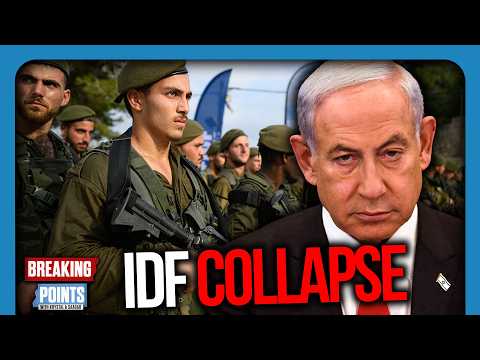
IDF Chief: Israeli Military COLLAPSING After Endless War
Key Takeaways
- •Israeli settler violence in the West Bank is not a fringe phenomenon — it's government policy with boots on the ground.
- •Breaking Points breaks down exactly how in 'IDF Chief: Israeli Military COLLAPSING After Endless War,' tracing how ministerial directives are driving coordinated settlement expansion, IDF logistical support for illegal outposts, and a deliberate erasure of the Oslo Accords' territorial divisions.
- •The death of 18-year-old settler Yehuda became the latest justification for a new wave of outposts and attacks — a pattern settlers themselves describe as intentional.
How Israeli Settlement Expansion Is Dismantling the Oslo Accords
The Oslo Accords carved the West Bank into three zones — Area A under Palestinian Authority control, Area B under shared administration, and Area C under full Israeli control. That framework is now being systematically picked apart by Israeli settlement expansion in the West Bank, with settlers pushing into all three areas and the Israeli government actively encouraging them to do it.
The Strategic Erasure of Area A: Palestinian-Controlled Territories Under Siege
Area A was supposed to be off-limits — full Palestinian Authority jurisdiction, no Israeli civilian presence. Settlers are now establishing outposts there anyway, with explicit backing from the Israeli government. The goal isn't just land. It's to make a two-state solution physically impossible by eliminating the territorial base it would require.
IDF's Growing Alignment With the Settler Movement
The Israeli Defense Forces are legally obligated to protect settlers, including those in outposts that are illegal under Israeli law. That obligation has quietly become something more operational — the IDF's central command is increasingly providing resources and planning support to new outposts, not just guarding them after the fact.
Military Logistics and Protection for Illegal Outposts
Some IDF soldiers privately resent being used as cover for settler expansion. Their commanders, however, are a different story. High-ranking military officials have been accused of coordinating logistical support for settler activity — effectively turning what looks like civilian land seizure into a state-backed operation with military infrastructure behind it.
Government-Coordinated Settler Violence in the West Bank
When 18-year-old settler Yehuda was killed, Israeli officials didn't call for calm. They called for revenge. New outposts went up. Attacks on Palestinians followed. The violence wasn't spontaneous — it was triggered by people with government portfolios.
Leadership Directives From Smotrich and Ben Gvir
Finance Minister Bezalel Smotrich and National Security Minister Itamar Ben Gvir have both issued explicit encouragements for settlers to expand their presence and confront Palestinians. These aren't vague political statements — they're operational signals to a movement that knows exactly what to do with them.
The Cycle of Provocation and Military Escalation
Settlers aren't just expanding into Palestinian territory — they're deliberately provoking a response. The logic is straightforward: if Palestinians react, that reaction becomes justification for a larger IDF operation and more land appropriation. Settlers have said this out loud.
How Settler Tactics Justify Larger Military Intervention
A group of settlers enters a Palestinian-controlled area. Palestinians respond. The IDF moves in for 'security.' An outpost gets established. Repeat. It's a documented playbook, and the Israeli government's role is less referee and more co-author.
The Role of Young Settlers in Territorial Expansion
Children as young as 11 are brought along on what settlers call 'land patrols' — incursions into Palestinian areas designed to generate friction. It functions, in practice, like a youth program for provocation. Both Smotrich and Ben Gvir came up through this same ideological pipeline, which says something about where the next generation of Israeli leadership is being shaped.
Breaking Points covers all of this in depth in IDF Chief: Israeli Military COLLAPSING After Endless War, connecting the ministerial directives to the boots-on-the-ground mechanics in a way mainstream outlets rarely do.
Our Analysis: Breaking Points gets the core right — this isn't rogue settlers acting alone, it's a state-backed land grab with uniforms nearby. The child soldiers angle deserves more attention than it got; grooming 11-year-olds into provocation ops is a long-term radicalization pipeline, not a footnote.
This fits a broader pattern of governments using plausibly deniable proxies to redraw borders — same playbook Russia ran in eastern Ukraine before 2022.
Watch the IDF central command alignment closely. When the military stops being a check on settler expansion and becomes its logistics arm, a two-state outcome doesn't just stall — it structurally disappears.
What's also underexplored here is the institutional feedback loop: ministers like Smotrich and Ben Gvir didn't emerge from nowhere. They were products of the same settler youth movement now being replicated with 11-year-olds. That means the radicalization pipeline isn't a side effect of current policy — it's the mechanism by which current policy reproduces itself across generations. The question isn't whether this generation of settler leadership will moderate. It's whether the next one will even have the vocabulary for moderation, given what they're being taught on 'land patrols.' That's the story the headline numbers on outpost counts and violence tallies consistently miss.
Frequently Asked Questions
How exactly is the Israeli government coordinating Israeli settlement expansion in the West Bank without triggering formal international accountability?
What actually happens to Area A under the Oslo Accords when settlers establish outposts there?
Is Israeli settler violence in the West Bank actually government policy, or is that an overstatement?
Why are IDF soldiers being used to protect outposts that are illegal under Israeli law?
What role do Smotrich and Ben Gvir actually play in driving West Bank settlement expansion?
Based on viewer questions and search trends. These answers reflect our editorial analysis. We may be wrong.
Source: Based on a video by Breaking Points — Watch original video
This article was created by NoTime2Watch's editorial team using AI-assisted research. All content includes substantial original analysis and is reviewed for accuracy before publication.