Fertilizer Shortage, Global Food Security & Gulf Conflict
Key Takeaways
- •Qatar's urea facility going offline removes 11% of global supply immediately, while the broader Persian Gulf shutdown accounts for 30-35% of global ammonia production.
- •The U.S. is insulated in the short term because domestic natural gas enables domestic nitrogen fertilizer production, but global prices rise regardless.
- •China imports nearly all its fertilizer components or finished products, making it the single most exposed major economy to a sustained nitrogen shortage.
Missiles Don't Just Hit Buildings
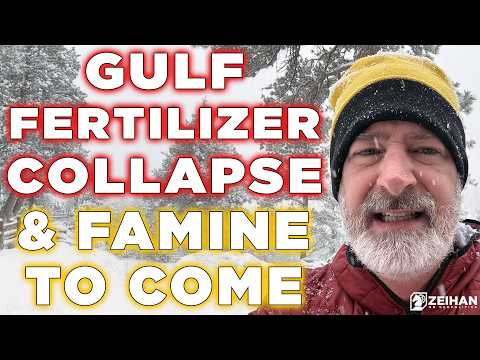
The Persian Gulf conflict has crossed a threshold that most coverage is missing entirely. Drone and missile attacks are now landing regularly inside Kuwait and the United Arab Emirates, hitting airports and energy infrastructure with enough consistency that interceptor stockpiles in both countries are reportedly running thin. When defense systems get depleted faster than they can be restocked, the strikes that get through stop being symbolic. They start being structural. As Peter Zeihan outlines in As Fertilizer Falls, Famine Will Follow || Peter Zeihan, one of those structural hits just took out Qatar's primary urea production facility, and the ripple is already moving toward your grocery bill. As explored in the debate over U.S. ground operations and Iran military options, the question of how far this conflict extends is no longer hypothetical.
Qatar Was Feeding the World and Nobody Noticed
Urea is the most widely used nitrogen fertilizer on the planet. It goes into the soil. The soil grows the food. That chain is not complicated, but it is fragile. Qatar, sitting on enormous natural gas reserves, had built itself into one of the world's critical nodes for nitrogen-based fertilizer production. That facility being offline is not a market disruption. It is 11% of global urea supply, gone. The Persian Gulf as a whole was responsible for somewhere between 30 and 35 percent of global ammonia output, and according to Zeihan, all of that has stopped. The fact that this did not make front pages the week it happened is a genuine editorial failure.
Potash and Phosphate Are Holding, For Now
Not every fertilizer category is in freefall. Potash, which comes primarily from Canada, Belarus, and Russia, is not being touched by Persian Gulf conflict. Phosphate production, anchored in Morocco, Peru, and parts of Florida, is similarly intact, though Zeihan notes Saudi Arabian phosphate output could see minor disruption. The global fertilizer picture is not uniformly catastrophic right now. It is specifically and severely broken in nitrogen. That distinction matters enormously for triage, but it does not make the nitrogen problem smaller.
Why the U.S. Is Not Panicking Yet
The United States produces its own oil and natural gas at scale. Natural gas is the feedstock for nitrogen fertilizer. Connect those two facts and you arrive at the reason American farmers are not staring down an immediate supply cliff. The U.S. can manufacture nitrogen fertilizers domestically, which means it can insulate its agricultural sector from the worst of this shortage even as global prices climb. Zeihan is clear that prices will rise for American buyers too, because markets are global. But shortage and expensive are different problems, and right now the U.S. is facing the second one, not the first. That is a position most of the world would take in a heartbeat.
China and India Are Exposed in Ways That Should Concern Everyone
China imports nearly all of its fertilizer components or finished fertilizer products. That sentence does not need elaboration. A country of 1.4 billion people, with agricultural output that depends on external supply chains for a core input, is now watching that supply chain get struck by missiles. India faces similar structural exposure, and Zeihan suggests the only path to relief for South Asia would involve securing direct resource access from Gulf states, a move that would require a significant reset in regional security posture. Neither vulnerability is short-term. Both point toward food stress at a scale that has historically not stayed contained within borders. For context on how conflicts at this scale tend to resolve, the analysis in how modern wars end is worth understanding alongside this one.
The Long Game Is Famine Arithmetic
The short-term crisis is measurable. Eleven percent of urea, thirty-plus percent of ammonia, offline now. The long-term picture that Zeihan sketches is harder to sit with. A chronic nitrogen deficit, compounded over years, does not produce a news event. It produces declining yields, quietly, season after season, until the gap between how many people need to be fed and how much food exists becomes impossible to paper over with trade or aid. The countries that cannot produce their own fertilizer inputs and cannot afford to outbid richer nations for scarce supply are the ones that get there first. The math on this is not complicated. It is just the kind of math that people prefer not to do. And for those tracking how U.S. strategic posture shapes these resource dynamics, the broader debate over U.S. military strategy toward Iran sits directly upstream of everything discussed here.
Our Analysis: Zeihan gets the nitrogen dependency problem right, and it deserves more attention than it typically gets. The casual assumption that food supply chains self-correct is exactly the kind of thinking that precedes a crisis nobody saw coming.
What the video underplays is the compounding effect. China and India are not facing a single supply shock. They are facing a structural input problem during a period when both nations are already managing slower economic growth. Hungry populations and weakening governments are a historically reliable combination for regional instability.
Watch South Asia first. The timeline is shorter than most analysts are pricing in.
Frequently Asked Questions
How quickly does a fertilizer shortage actually translate into food shortages at the grocery store?
Which countries are most vulnerable to the fertilizer shortage and global food security collapse if the Persian Gulf conflict continues?
Is the claim that 30-35% of global ammonia production has gone offline verified anywhere beyond Zeihan's video?
Why can't countries just switch fertilizer suppliers if Qatar and the Persian Gulf go offline?
Does the U.S. being insulated from the nitrogen fertilizer crisis mean American food prices stay stable?
Based on viewer questions and search trends. These answers reflect our editorial analysis. We may be wrong.
Source: Based on a video by Peter Zeihan — Watch original video
This article was created by NoTime2Watch's editorial team using AI-assisted research. All content includes substantial original analysis and is reviewed for accuracy before publication.