Dhaka Population Density Urban Challenges: A Megacity's Struggle
Key Takeaways
- •Dhaka's population has more than doubled since 2000, reaching over 36 million — making it one of the most densely populated urban areas on the planet.
- •By 2050, that number is projected to hit 52 million, compressing an already overwhelmed infrastructure further.
- •Traffic, housing shortages, and sanitation failures aren't edge cases in Dhaka — they're the baseline.
From 18 Million to 36 Million in 26 Years
Dhaka didn't creep toward megacity status — it sprinted. Since 2000, the population has more than doubled, and the city's physical infrastructure has "not kept pace with that growth" in any meaningful way. Roads built for a fraction of current demand now carry some of the heaviest traffic loads of any city on Earth. The density isn't just a statistic; it's something you feel in the air, in the noise, in the sheer compression of human activity into every available square metre.
For context, most cities that grew this fast had decades of industrial investment and urban planning running ahead of the population curve. Dhaka largely did not. The growth came first. The infrastructure is still catching up — and in many areas, it isn't.
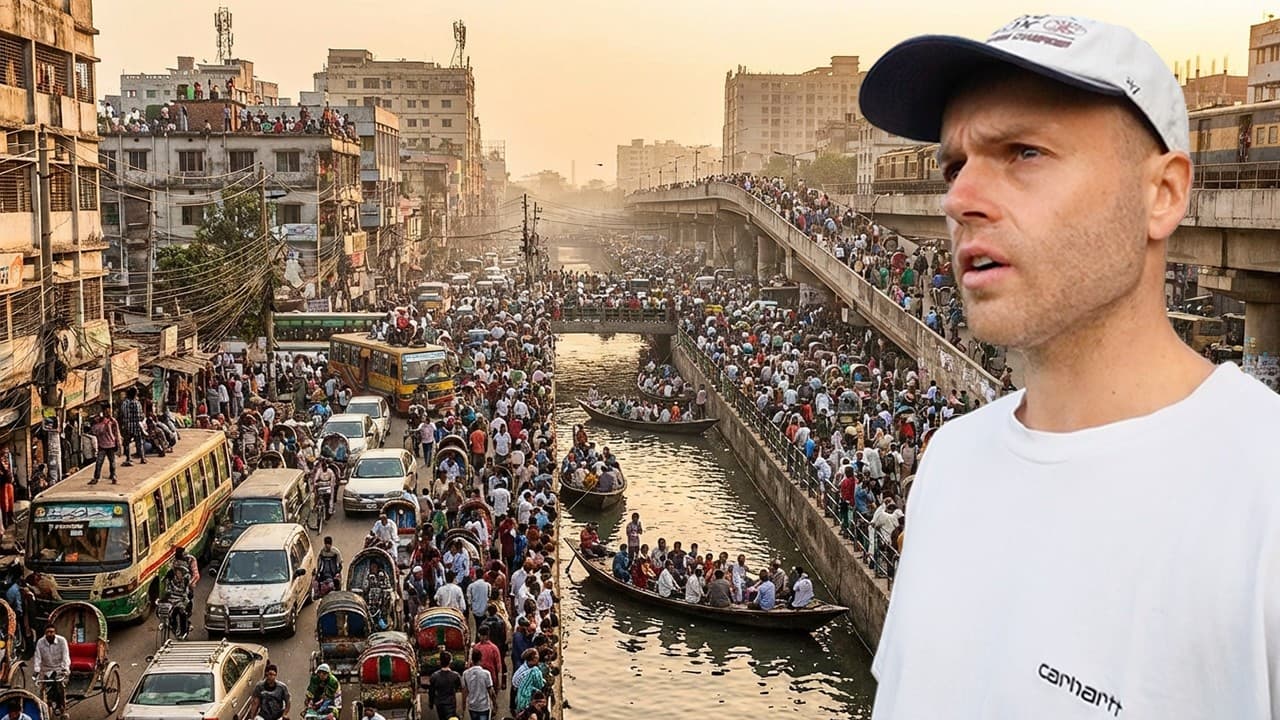
Indigo Traveller's recent video The World's Most Densely Populated City (36 Million People) puts street-level footage to these numbers, documenting the daily reality of living inside a city that has outgrown nearly every system designed to support it.
What Breaks First When a City Gets This Crowded
Roads That Were Never Designed for This
Traffic in Dhaka operates less like a flow and more like a slow-moving mass. Rickshaws, which remain a primary mode of transport, share road space with vehicles in a city where the road network was never designed to handle either at this volume. The result is congestion that doesn't resolve at off-peak hours — because in a city of 36 million, there are no real off-peak hours.
The comparison to other dense cities is instructive. Tokyo, often cited as the world's largest metropolitan area, functions with relative efficiency because it built transit infrastructure ahead of population growth. Dhaka's growth trajectory left no room for that sequencing.
Our Analysis: The video does something useful by putting a human face on a density statistic that's easy to cite and hard to visualise. Thirty-six million people in one city is genuinely difficult to process, and street-level footage closes that gap in a way that a population chart doesn't. Where it falls short is in the infrastructure specifics — the video shows the symptoms clearly but doesn't press hard on the structural causes. Dhaka's density crisis isn't just a function of population growth; it's a function of internal migration patterns driven by rural land loss, which is a distinct problem with distinct policy levers.
The 52 million projection gets mentioned and then largely left there, which undersells how compressed the planning timeline actually is. Urban transit systems, water infrastructure, and housing stock at that scale take 20 to 30 years to build properly. Dhaka has roughly 25 years. That's not a comfortable margin — it's a deadline.
What the video also doesn't interrogate is the economic architecture sustaining this growth. Dhaka's garment sector — one of the largest in the world — is a significant pull factor drawing rural workers into the city. That's not incidental to the density problem; it's central to it. Any credible urban planning response has to reckon with the fact that the city's economic engine is also its population accelerant. Decentralising industrial zones, investing in secondary cities, and building liveable density outside Dhaka's core are all policy options that get discussed in planning circles but rarely translate into coordinated action.
There's also a climate dimension that deserves more attention than it typically receives in coverage like this. Dhaka sits in a low-lying delta region acutely vulnerable to flooding and cyclone activity. As climate displacement from coastal and riverine areas intensifies over the coming decades, the city is likely to absorb a significant share of that movement on top of existing growth projections. The 52 million figure may be conservative. Planning for a city of that scale is hard enough. Planning for one whose population ceiling keeps rising due to factors outside urban managers' control is a categorically different challenge — and one that the international development community has been slow to resource adequately.
Frequently Asked Questions
What are the biggest urban challenges created by Dhaka's population density?
Why is Dhaka so densely populated compared to other major cities?
How does Dhaka's population density actually compare to other megacities?
Can Dhaka realistically support 52 million people by 2050?
Based on viewer questions and search trends. These answers reflect our editorial analysis. We may be wrong.
Source: Based on a video by Indigo Traveller — Watch original video
This article was created by NoTime2Watch's editorial team using AI-assisted research. All content includes substantial original analysis and is reviewed for accuracy before publication.