Berlin's Solo Travel Challenge With No Money: Did She Survive?
Key Takeaways
- •Both a male and female participant completed a 24-hour no-money survival challenge in Berlin, relying entirely on strangers for food, shelter, and cash.
- •Anna Kramling, a chess expert, secured a potential host by infiltrating a private Swedish tour — within hours of being dropped with nothing.
- •Berlin, widely flagged by locals as too 'strict' for this kind of challenge, turned out to be surprisingly hospitable once participants actually approached people.
What Is the Zero-Budget Travel Challenge?
The premise is deliberately uncomfortable: you get dropped in an unfamiliar city with no money, no contacts, and no safety net. From there, you have 24 hours to earn cash through stranger interactions, find free food, and secure a place to sleep — all without calling in favours from anyone you already know. Yes Theory has run versions of this challenge before, but this Berlin iteration added a specific wrinkle: a direct response to viewers who questioned whether women could realistically attempt the same thing. Watch the full experiment in Yes Theory's Abandoned in Germany with $0 for 24 Hours (Man vs. Woman).
The rules are structured around mini-challenges — small tasks that require engaging with locals and that pay out small amounts of money when completed. Beat someone at chess. Compliment ten strangers. Race a local. Each task is designed to force interaction, which is the actual point. The money is almost secondary. Related: Osaka's Japanese Nightlife Culture: Unfiltered Guide
The Berlin Experiment: Man vs. Woman
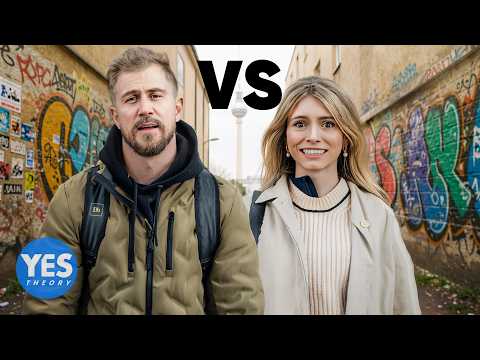
Anna Kramling, described as a chess genius with serious charisma, was chosen to represent the female side of the experiment. Thomas acted as game master while also running his own parallel version of the challenge. A coin flip sent Anna out first. She landed in Berlin expressing equal parts fear and determination, which, honestly, is the correct emotional response to being abandoned in a foreign city with nothing in your pockets.
Berlin was flagged early — by locals, by the participants themselves — as a particularly tough city for this kind of social experiment. The reputation is for reserve, not warmth. That framing set up the tension that carried the whole video. Related: Dhaka Population Density Urban Challenges: A Megacity's Struggle
How to Earn Money Through Travel Challenges
Mini-Challenges and Stranger Interactions
Anna's first tasks included beating a stranger at chess and complimenting ten people. She completed both. Thomas, meanwhile, approached strangers for compliments and sought out local wisdom, and a coffee vendor handed him a free drink unprompted — which is either luck or proof that leading with openness gets results faster than leading with a script.
Thomas also raced a stranger for money at one point, reflecting afterward that the whole structure of these challenges exists to manufacture the kind of interactions most people talk themselves out of having. Without the external pressure of the challenge, he noted, he simply wouldn't have approached that many people in a single day. That's the mechanism: the challenge removes the excuse. Related: Mayotte Island France Crime Safety: Paradise or Peril?
Finding Free Shelter and Accommodation
Building Trust with Locals in Unfamiliar Cities
Finding food and earning small amounts of cash is the easy part. Finding somewhere to sleep is where these challenges actually get hard. Anna's breakthrough came through a private Swedish tour she somehow managed to join mid-route. She connected with the tour guide, Susanna, who offered her contact details as a potential overnight lead. For a challenge set in a city locals had already written off as inhospitable, that was a significant early win.
Thomas had a rougher path. Multiple people declined to host him — politely, but firmly. One person was already hosting someone. Another expressed genuine doubt that anyone in Berlin would take in a stranger for the night. The couch-surfing app route was considered and ruled out by his team. Then he met Chris, who suggested a late-night sauna trip before eventually offering access to a friend's empty apartment. Unconventional, but functional. This kind of urban hospitality — not warm exactly, but practical — is actually more common than people assume, as anyone who's navigated unfamiliar cities on zero budget will tell you.
Our Analysis: The gender framing here is doing more work than the video fully commits to. Anna succeeds — clearly, quickly, impressively — and the video treats that as the answer to the viewer question. But the more interesting data point is Thomas's sauna deliberation. He ran a verification process before accepting a stranger's invitation that the video presents as personal caution, not as something structurally different about how men and women navigate these situations. Anna almost certainly ran the same calculus the entire day. The video just didn't linger on it the way it lingered on Thomas's moment of doubt.
The mini-challenge mechanic is smarter than it looks. Framing 'talk to strangers' as a task with a cash reward removes the social awkwardness of approaching people for no reason. It gives both parties a script. The stranger knows why you're there; you know what you're asking for. That structure is probably responsible for 80% of the positive outcomes in this video, and it's replicable by anyone travelling on a tight budget who's willing to be slightly ridiculous in public.
There's also a broader point worth making about what Berlin's reputation actually measures. When locals pre-emptively apologise for their own city's coldness, that's not an accurate forecast — it's a social script. The actual data from this video, and from Yes Theory's broader catalogue, consistently shows that cities with reputations for unfriendliness tend to harbour deep reserves of practical generosity once the interaction gets past the initial awkward threshold. Berlin didn't fail the challenge. The challenge failed the stereotype.
Frequently Asked Questions
How do you travel when you've got no money?
Where can you travel solo and cheaply as a beginner?
Can women realistically do extreme travel challenges like being abandoned in a city with no money?
How do you find free accommodation when traveling with no money?
What is the solo travel challenge with no money actually testing — survival skills or social skills?
Based on viewer questions and search trends. These answers reflect our editorial analysis. We may be wrong.
Source: Based on a video by Yes Theory — Watch original video
This article was created by NoTime2Watch's editorial team using AI-assisted research. All content includes substantial original analysis and is reviewed for accuracy before publication.