Claude Code buddy virtual pets feature: Terminal Companions
Key Takeaways
- •Claude Code launched a virtual pet 'buddy' system on April 1st, letting users hatch a permanent coding companion directly inside their terminal.
- •In his video 'Claude Code Just Gave Everyone Virtual Pets (April Fools?),' @nateherk walks through the fully functional feature, which generates a unique pet tied to each user's account and coding history.
- •The pet has personalized stats, a rarity tier ranging from common to legendary, and can comment on your code in real time, all without touching your token usage.
A Pet Hatcher Hiding Inside Your Terminal
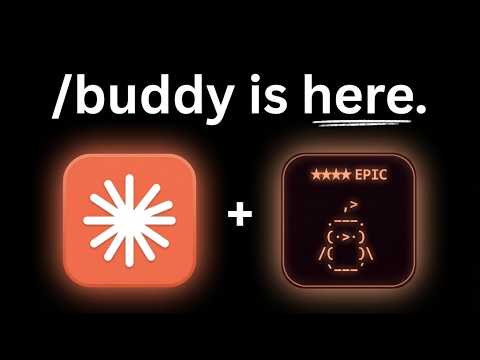
Claude Code's new buddy system showed up on April 1st, which is either perfect timing or the most on-brand way Anthropic could have launched something this weird. The feature is accessed through a simple /buddy command typed directly into your terminal session. Type it, and you get a companion: a named, described, stat-bearing virtual creature that lives inside your coding environment. As @nateherk demonstrates in Claude Code Just Gave Everyone Virtual Pets (April Fools?), the pet that appeared for him was Vortex, a common turtle, which is honestly a very reasonable spirit animal for someone who codes for a living. The feature runs in the terminal proper, not inside the VS Code extension, so users need to update Claude Code to version 2.1.89 and work from a direct terminal session to access it.
What Actually Determines Your Pet
This is where it gets interesting. The pet you receive is not random in the traditional sense. It is deterministically seeded from your user ID, which means Anthropic's system is generating a specific creature for a specific account, every time, consistently. On top of that, the pet's stats reflect your actual coding history. Traits like patience or chaos are not placeholder labels; according to the video, they are shaped by how you have actually behaved inside Claude Code sessions over time. The result is a companion that is, in some measurable way, a portrait of you as a developer. That's either a fun easter egg or a slightly unnerving mirror, depending on what your chaos score comes back as. Related: Google's TurboQuant AI Memory Compression: Faster, Cheaper AI
Rarity Tiers and the Collector's Trap
The buddy system includes at least 18 distinct species, organized across five rarity tiers: common, uncommon, rare, epic, and legendary. There is also a shiny variant layer on top of that, which works the way it sounds if you have ever played a certain monster-catching franchise. Higher rarity pets get visual differentiators, things like hats or unusual eye designs, that make them visually distinct from their common counterparts. The collection mechanics are real enough that users will almost certainly start comparing pets, even though the system currently caps each account at one permanent companion. It is a smart design move: scarcity without grind, since you cannot farm for a better one.
Permanent by Design, Not by Accident
Once your pet is generated, it is yours. There is no re-roll option, no reset, no way to try again if you wanted a legendary and got a common turtle instead. The pet is tied to the account and that is the end of the conversation. @nateherk notes this in the video, and it is worth sitting with for a second, because it is an unusual design choice for what is ostensibly a novelty feature. Most toylike additions to developer tools include an escape hatch. This one does not. Whether that creates attachment or frustration probably depends on your rarity tier, and Vortex the common turtle is not offering any comfort on that front. Related: MKBHD's Bluey Phone Review & Minimalist Phone Benefits
How the Pet Actually Behaves During a Session
The interaction model is simple but functional. You can type /buddy pet to show affection, address the pet by name to prompt a response, or use /buddy off to dismiss it entirely. Responses appear in a speech bubble inside the terminal, which is a visual detail that does more tonal work than it probably should. During the video's live demo, Vortex interjected a comment while @nateherk was working through a game development task, and the comment was contextually relevant to what was happening on screen. The pet also responded to a direct question, though the response was a wave rather than anything useful, which is a very accurate simulation of asking a coworker for help at the wrong moment. None of this touches performance or token counts, which is the one promise that actually matters to anyone running real workloads. For a sense of where AI tooling is pushing at the edges of capability and weirdness simultaneously, the gap between a pet that waves and a model that reasons is worth keeping in mind, as explored in the Our Analysis: Anthropic shipped something that does absolutely nothing useful, and people love it. That should tell you more about the state of developer tooling than any feature roadmap ever could. The permanent pet angle is the real story here. No re-rolls means your coding history literally determines what companion you get. That's not a gimmick, that's a mirror. Someone who writes Python scripts at 2am gets a different creature than someone grinding TypeScript PRs all week. Whether this sticks around past April or quietly disappears, Anthropic just proved their developers have a sense of humor. That's underrated in a space this serious about itself. Based on viewer questions and search trends. These answers reflect our editorial analysis. We may be wrong. Source: Based on a video by @nateherk — Watch original video This article was created by NoTime2Watch's editorial team using AI-assisted research. All content includes substantial original analysis and is reviewed for accuracy before publication.Frequently Asked Questions
How does the Claude Code buddy virtual pets feature actually work?
How does the virtual pet rarity system work in Claude Code?
Does Claude Code keep your code private when using the buddy feature?
Can you interact with your Claude Code buddy pet during a session?
Is the Claude Code virtual pet feature a real launch or an April Fools joke?
Related Articles