How Paragliders Fly Without Fuel: The Science of Thermals
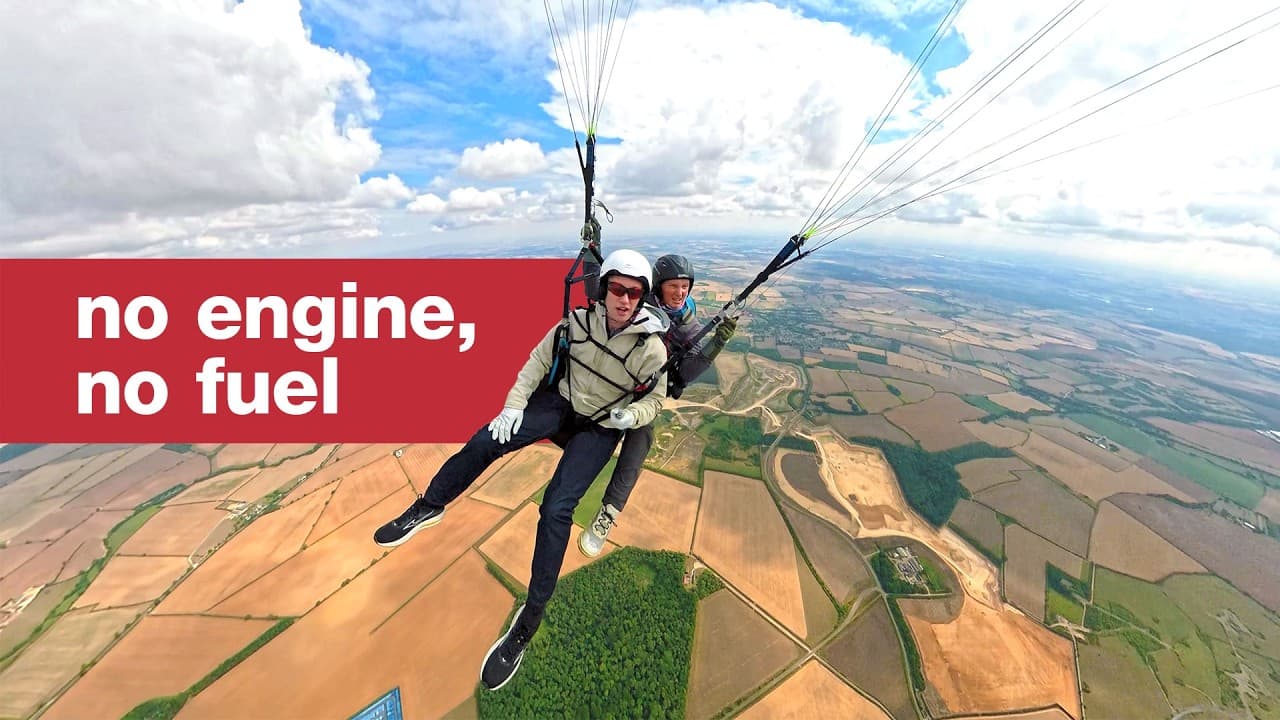
Key Takeaways
- •Paragliders stay airborne by circling inside thermals — rising columns of warm air — then gliding to the next one, repeating the process to cover hundreds of kilometers without any engine.
- •A paraglider wing is not a parachute: it's an inflated nylon aerofoil engineered for lift and forward flight, controlled entirely by brake handles that deform the trailing edge.
- •Paragliding has a lower cost of entry than almost any other air sport — no fuel, minimal equipment, and no aircraft maintenance bills.
The Atmosphere Is the Engine
The core trick behind unpowered flight is embarrassingly simple once you hear it. The sun heats the ground. The ground heats the air directly above it. That warm air is less dense than the cold air around it, so it rises — sometimes fast enough to carry a pilot and their wing upward at several meters per second. These columns of rising air are thermals, and they are the only reason cross-country paragliding exists.
Mick, the ex-RAF pilot Tom flies with in the video, explains that not all ground is equal. Harvested fields, straw bales, dark-coloured surfaces — anything that absorbs heat faster than its surroundings can act as a trigger point where a thermal breaks away and starts climbing. Pilots learn to read the landscape below them the way a sailor reads the water. The sky above tells the same story: cumulus clouds form at the top of thermals, marking the column's ceiling and acting as a visible waypoint for pilots hunting their next source of lift. It's meteorology as navigation, which is a genuinely strange skill set to develop. Related: Bob Lazar S4 Alien Technology: Joe Rogan & Area 51
Climb, Glide, Repeat
Cross-country paragliding — XC flying — is built on a single repeating cycle. Find a thermal, circle inside it to gain altitude, then glide downwind toward the next one before you sink too low. The efficiency of that glide phase determines how far you can travel between thermals, and the strength of each thermal determines how quickly you can climb back up. In good conditions, pilots can cover hundreds of kilometers in a single day doing nothing but optimising that loop.
Josh, another pilot Tom meets at the former air force base in Rutland, is aiming for a 100-kilometer flight on the day of filming. The catch: you land wherever the thermals run out, which means the return journey is entirely your problem. No engine means no going back the way you came. That detail alone reframes what cross-country flying actually involves — it's less a leisure activity and more a committed logistical exercise with a very pleasant middle section. Related: UK's Last Bell Foundry: The Bell Casting Process Traditional Foundry
Not a Parachute With Ambitions
The comparison to parachutes comes up early in They can fly 200 miles with no fuel. Here's how. by Tom Scott, and it's worth addressing properly. The two things are solving opposite problems: a parachute slows a falling object down, while a paraglider is designed to generate lift and sustain forward flight. The wing is a large nylon aerofoil — no rigid frame, no struts — that holds its shape purely because air is forced into openings along the leading edge, pressurising the internal cells. Remove the airflow and it deflates. That's a fundamentally different engineering philosophy from anything with a solid wing, and it's part of why the whole system packs down small enough to carry on your back. Related: Black Hole Formation from Stellar Collapse Explained
For anyone curious about the broader physics of how atmospheric pressure and fluid dynamics interact in flight contexts, the science on display here is a useful starting point.
Our Analysis: The video does a clean job explaining thermals, but it quietly sidesteps how much of cross-country paragliding is failure management. Josh's 100km attempt gets framed as an adventure — land wherever you end up, sort out the return journey later. That's accurate, but it's also the polite version. In practice, XC flying involves a lot of landing in farmers' fields, calling someone to collect you, and driving home with a deflated wing in the back seat. The sport's accessibility pitch is genuine, but the gap between 'affordable to start' and 'reliably useful for going somewhere' is wider than the video implies.
Mick's RAF background is mentioned and then left alone, which is a missed thread. Military pilots reading thermals for unpowered gliders is a specific skill set with a specific history — gliders were used operationally in WWII precisely because they're silent and fuel-free. The same atmospheric physics Tom is experiencing as a leisure activity was once a tactical problem. That context would have added weight to what otherwise stays in the register of 'surprisingly fun hobby.'
Frequently Asked Questions
How do paragliders stay in the air for so long without fuel?
How can a glider fly very high without any engine?
What's the actual difference between a paraglider and a parachute?
How far can a paraglider fly in a single flight?
Can paragliding cause vertigo or disorientation?
Based on viewer questions and search trends. These answers reflect our editorial analysis. We may be wrong.
Source: Based on a video by Tom Scott — Watch original video
This article was created by NoTime2Watch's editorial team using AI-assisted research. All content includes substantial original analysis and is reviewed for accuracy before publication.