Why Antimatter Is Impossible To Ship: CERN's Antiproton Challenge
Key Takeaways
- •Antimatter is estimated to cost quadrillions of dollars per gram — CERN's entire 25-year output wouldn't heat a milliliter of water by one degree.
- •A portable Penning trap can now store antiprotons for over 600 days, making limited transport possible for the first time.
- •CERN produces roughly 10 billion antiprotons per year — which sounds like a lot until you realise that's still less than a trillionth of a gram.
What Actually Makes Antimatter Impossible to Ship
The problem isn't just that antimatter is rare. It's that the universe is aggressively trying to destroy it at all times. The moment an antiproton touches a regular proton — or any normal matter at all — both particles annihilate, converting nearly all their combined mass directly into energy. That's not a chemical reaction. That's the most energetic process known in physics, and it happens instantly. So the container you ship antimatter in cannot touch the antimatter. At all. Ever.
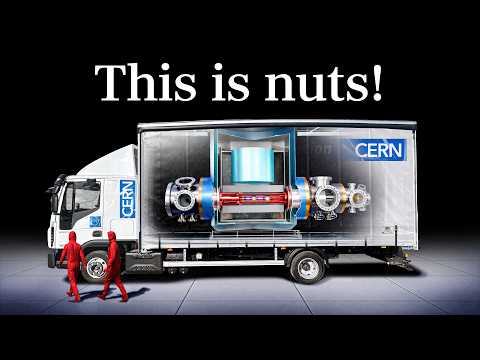
CERN's solution is the Penning trap: a device that suspends charged antimatter particles using a combination of magnetic and electric fields inside an ultra-high vacuum. No walls, no contact, no annihilation. It's an elegant fix to an almost comically hostile problem, and it took decades to develop well enough to be reliable.
The Price Tag That Makes Everything Else Look Cheap
Before you even get to the storage problem, you have to make the stuff. At CERN, protons are accelerated to near light speed and fired into a dense iridium target. The collision shatters protons into a spray of quark-antiquark pairs, and occasionally — occasionally — three antiquarks combine into an antiproton. CERN produces roughly 10 billion antiprotons per year, which sounds productive until you price it out — that output adds up to less than a trillionth of a gram over 25 years. Estimates put antimatter at quadrillions of dollars per gram. For context, that makes gold look like gravel. CERN's annual output wouldn't heat a milliliter of water by one degree. The energy cost alone of running the accelerators dwarfs the value of anything you'd produce, which is why antimatter as a fuel source or weapon remains firmly in the science fiction column for now — as Veritasium explains in Why It's Almost Impossible To Ship Antimatter, the physics here is unforgiving in ways that no amount of engineering ambition can paper over.
Our Analysis: The video does a clean job explaining why antimatter can't be shipped in bulk, but it skips the most interesting practical implication of the portable Penning trap: the BASE experiment didn't just prove storage is possible, it proved the magnetic containment can survive mechanical transport. That's the actual barrier no one talks about. Building a Penning trap is hard. Building one that doesn't catastrophically fail when you put it in a van is a different engineering problem entirely, and CERN quietly solved it.
The cost framing also deserves more scrutiny. Quoting quadrillions per gram is technically accurate but misleading — antimatter isn't priced like a commodity, it's priced by dividing total facility operating costs by output. If you scaled production, the per-gram cost would collapse. The real ceiling isn't price, it's energy: you cannot get more energy out of antimatter annihilation than you put into making it. That's the actual reason antimatter fuel stays fictional.
What's also underappreciated is how the portable trap reframes the research conversation. For decades, antimatter experiments were anchored to the accelerator that produced the particles — you couldn't take your experiment anywhere, because the antimatter couldn't go anywhere. The BASE collaboration's 2023 transport demonstration changes that in a quiet but meaningful way. Precision measurements of antiproton properties, which require extremely stable and isolated environments, could now in principle be conducted at facilities optimized for that kind of measurement rather than for particle production. That's not a path to antimatter fuel or weapons. But it is a genuine expansion of what experimental physics can do, and it's the kind of incremental, unglamorous progress that tends to matter more in the long run than the headline numbers about quadrillions of dollars per gram.
The Angels and Demons comparison the video leans on is useful shorthand, but it also obscures something worth stating plainly: the gap between current antimatter capability and anything resembling a practical application isn't a engineering gap. It's a physics gap. No near-future technology closes it. The portable Penning trap is a remarkable achievement — it just isn't a stepping stone to the thing most people imagine when they hear the word antimatter.
Frequently Asked Questions
What is the cost of 2 grams of antimatter?
What will happen if a human touches antimatter?
Why can't we just transport the antimatter CERN produces if it's already being stored?
How many bananas would it take to produce 1 gram of antimatter?
Why is antimatter so impossible to ship even if the physics of storing it are understood?
Based on viewer questions and search trends. These answers reflect our editorial analysis. We may be wrong.
Source: Based on a video by Veritasium — Watch original video
This article was created by NoTime2Watch's editorial team using AI-assisted research. All content includes substantial original analysis and is reviewed for accuracy before publication.