UK's Last Bell Foundry: The Bell Casting Process Traditional Foundry
Key Takeaways
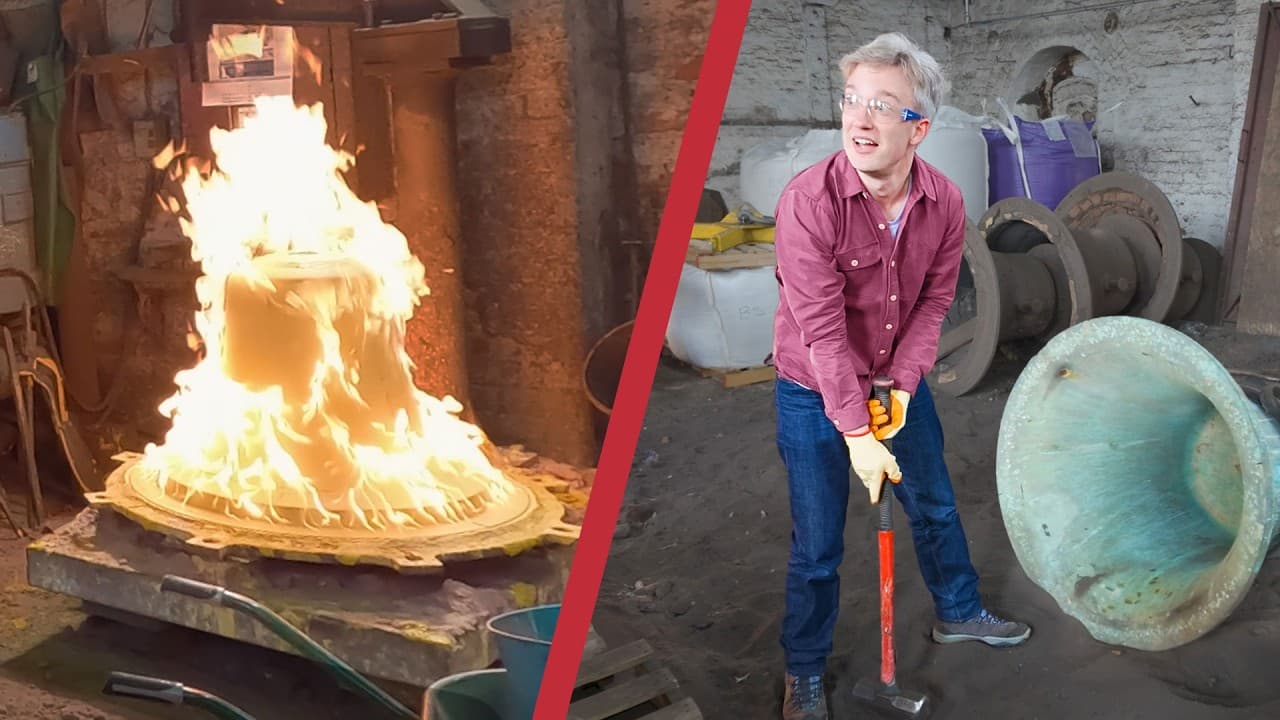
- •The John Taylor Bell Foundry in Leicestershire is the last operational bell foundry in the UK, and Tom Scott spent a day watching — and occasionally helping — them cast four new bronze bells.
- •The process is older than almost anything still practiced in British manufacturing: loam made from goat's hair and horse manure, molds buried in sand, molten bronze at 1200°C, and a deliberate slow-cooling method that would be considered wrong in virtually any other metal casting context.
- •The whole operation ended with an improvised pit dig when the team poured more metal than expected.
The Last Foundry Standing
In his video I helped break a 142-year-old bell, and that's okay., Tom Scott visits the John Taylor Bell Foundry in Leicestershire — the only place in the UK still casting bells the traditional way. Not 'one of the last.' The last. Every other operational bell foundry in the country is gone, which puts this one in a strange position: it's simultaneously a working business and a living museum of industrial technique that nowhere else has bothered to keep alive. Foreman Antony and his colleague Sam — who started there at 16 — are among the small number of people on earth who actually know how to do this. That's either inspiring or quietly alarming depending on how you feel about institutional knowledge disappearing.
Mud, Hair, and Manure: The Mold That Shouldn't Work
The outer bell molds are made from loam — a dense, sticky mixture of sand, clay, water, goat's hair, and horse manure. That last ingredient isn't a historical quirk left in for tradition's sake. The organic material in the loam burns away when the molten metal hits it, leaving tiny channels throughout the mold wall. Those channels let the gases produced during casting escape. Without them, pressure builds, and the mold fails catastrophically. The inner core takes a different approach entirely: chemically bonded sand that sets quickly but can't go in an oven, so instead it's cured by burning off an alcohol-based coating applied to the surface. Two completely different material strategies, one for each side of the same mold. Both have to be bone dry before any metal gets near them — moisture at 1200°C doesn't stay moisture for long, and steam expanding inside a sealed mold does exactly what you'd expect.
The Slow Cooling Counterintuitive
Here's the thing that breaks the pattern of everything else you know about metal casting: bells have to cool slowly. In most foundry work, controlled rapid cooling is the goal — it tightens the grain structure and gives you a harder, denser material. For bells, that same approach produces the wrong acoustic result. The tone of a bell is a function of how the metal solidified, and fast cooling throws that off in ways that can't be corrected after the fact. So after each pour, the team covered the molds with sand to hold the heat in and slow the whole process down. It's a deliberate reversal of standard practice, and it works precisely because bells aren't structural components — they're instruments.
Our Analysis: What Tom Scott's visit to John Taylor captures — almost incidentally — is the particular fragility of knowledge that lives in hands rather than manuals. The foundry hasn't survived because someone archived its methods in a format anyone could reproduce. It's survived because specific people showed up, learned by doing, and stayed. Sam starting at 16 isn't a charming biographical detail; it's the actual mechanism by which this continues to exist at all. Apprenticeship as preservation strategy.
There's a broader industrial story here that the video gestures at without fully unpacking. The UK's manufacturing base has spent decades shedding exactly this kind of specialist craft capacity — not because the products stopped being needed, but because the economics of scale made consolidation look rational until, suddenly, there was nothing left to consolidate. Bell foundries are an extreme case, but the pattern is everywhere: niche expertise that looks redundant until the moment it isn't, at which point rebuilding it from scratch is somewhere between very difficult and effectively impossible.
The slow-cooling detail is worth dwelling on because it illustrates something that gets lost in most conversations about traditional versus modern manufacturing. The 'wrong' method — the one that would be a defect in any other context — is correct here because the optimization target is different. Bells aren't judged by tensile strength or dimensional tolerance; they're judged by how they sound. The accumulated knowledge of how to hit that target, built up over centuries of empirical trial rather than derived from materials science, isn't easily reverse-engineered. You can't just read the metallurgy literature and work backwards to the right answer. The answer is already baked into the practice.
The improvised pit dig at the end — the team having to rapidly excavate when the pour ran larger than anticipated — is also quietly revealing. This is a live process with real variance, managed by people experienced enough to adapt on the fly. That's not a gap in the operation's professionalism; it's evidence of the kind of practical judgment that only comes from years of watching things go slightly wrong and figuring out why. No procedure document covers it. The knowledge is in the room, in the people, and it walks out the door when they retire.
Frequently Asked Questions
How does the traditional bell casting process work at a foundry?
Why do bells have to cool slowly when most metal casting does the opposite?
Why is horse manure used in bell mold construction?
Is John Taylor Bell Foundry really the last bell foundry in the UK?
Can bronze from old bells be melted down and recast into new ones?
Based on viewer questions and search trends. These answers reflect our editorial analysis. We may be wrong.
Source: Based on a video by Tom Scott — Watch original video
This article was created by NoTime2Watch's editorial team using AI-assisted research. All content includes substantial original analysis and is reviewed for accuracy before publication.