Black Hole Formation from Stellar Collapse Explained
Key Takeaways
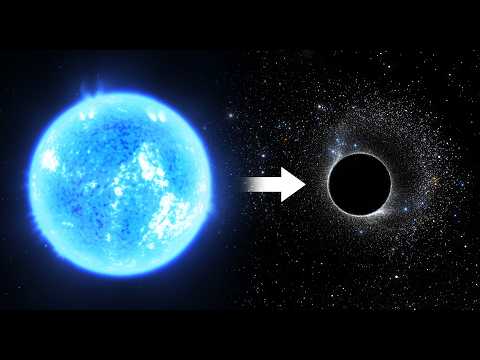
- •ScienceClic's video 'What does the formation of a black hole look like?' breaks down the real physics of black hole formation from stellar collapse, tracing the process from a dying massive star through supernova explosion to the moment an event horizon locks into existence.
- •The video focuses on what an outside observer would actually witness during that collapse: a star that appears to slow, redden, and freeze at its own boundary before vanishing into shadow.
- •Using the Oppenheimer-Snyder theoretical model, ScienceClic makes the case that black hole formation is not a slow cosmic drama but a process completed in milliseconds, even if it looks frozen from the outside forever.
Why Most Stars Never Become Black Holes
The Sun is not going to become a black hole. That's not a reassurance, it's just physics. When a star like ours exhausts its nuclear fuel, gravity wins a partial victory and compresses the remaining core into a white dwarf, dense but stable, held up by electron pressure. Neutron stars are the next tier, forged from slightly more massive stellar cores, where matter is crushed until protons and electrons merge into neutrons. But complete gravitational collapse, the kind that produces an actual black hole, requires a star with an initial mass at least 20 times that of the Sun, according to ScienceClic. Below that threshold, something always pushes back. Above it, nothing does. There is something almost brutal about the simplicity of that cutoff.
The Supernova Is Not the End, It's the Beginning
When a sufficiently massive star runs out of fuel, it does not quietly collapse. It detonates. The outer layers of the star are blown apart in a supernova explosion while the core, stripped of the outward pressure that radiation had been providing for millions of years, falls inward with nothing to stop it. In What does the formation of a black hole look like?, ScienceClic explains that this core collapse happens within milliseconds — the entire gravitational implosion that produces a black hole occurs faster than most biological processes. The explosion you see is almost a distraction from what is happening at the center, which is a point of no return being born in the time it takes to blink.
Our Analysis: ScienceClic gets something most explainers botch entirely. The event horizon isn't a surface a black hole has. It's a surface made of light that gave up. That reframe alone is worth your eight minutes.
What the video leaves hanging is the observer problem. You never actually see a black hole form. You see a star freeze and fade. The collapse technically never completes from your vantage point. So in a real sense, every black hole you've ever read about is still, perpetually, forming. Nobody says that out loud.
There's a broader implication worth sitting with. Physics is full of phenomena that are complete in one reference frame and never-ending in another. Black hole formation might be the starkest example of that, but it's not the only one. The universe doesn't care whether an event looks finished to you. It just happens, or doesn't, depending on where you're standing. ScienceClic's framing quietly exposes how much of our intuition about cause and effect is local and fragile.
The Oppenheimer-Snyder model, which the video leans on, is also worth flagging for what it assumes away. It treats the collapsing star as a perfectly uniform sphere in an otherwise empty universe. Real stellar collapse is messier — magnetic fields, rotation, asymmetric mass distribution, neutrino pressure. The clean theoretical picture is a useful skeleton, but actual black hole formation is almost certainly noisier. That doesn't invalidate the video's core argument. It just means the millisecond collapse is a lower bound on complexity, not an upper one.
For a general audience explainer, this one is unusually honest about the limits of human observation. Most science communication glosses over the gap between what happens and what we can see. The fact that the formation event is, from our position, permanently frozen in time isn't a footnote here. It's the whole point.
Frequently Asked Questions
What does black hole formation from stellar collapse actually look like to an outside observer?
How do black holes form from dying stars, step by step?
What happens at the event horizon when a black hole forms?
Why doesn't the Sun collapse into a black hole when it dies?
Is the Oppenheimer-Snyder model still how scientists explain black hole formation?
Based on viewer questions and search trends. These answers reflect our editorial analysis. We may be wrong.
Source: Based on a video by ScienceClic — Watch original video
This article was created by NoTime2Watch's editorial team using AI-assisted research. All content includes substantial original analysis and is reviewed for accuracy before publication.