Huggbees Unpacks 'Tattooed Teenage Alien Fighters from Beverly Hills'
Key Takeaways
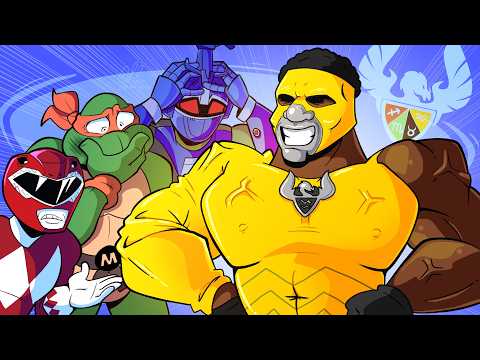
- •Huggbees' video 'The Knockoff to End All Knockoffs' tears apart Tattooed Teenage Alien Fighters from Beverly Hills, a 90s American children's show that tried to replicate Power Rangers without the one ingredient that made Power Rangers work: actual Japanese tokusatsu footage to adapt.
- •Where shows like Power Rangers and VR Troopers were built by re-dubbing existing Japanese productions, Tattooed Teenage Alien Fighters was an original American production faking that format from scratch, making it a knockoff of a knockoff.
- •The result was a single-season disaster featuring blob-like mentor Nimbar, incoherent constellation-themed character names, bodybuilder actors posing as 17-year-olds in revealing costumes, and action sequences so cheap that villains had to be defeated by playing footage in reverse.
What Tattooed Teenage Alien Fighters from Beverly Hills Actually Was
Most people who stumble across the title assume it's a fever dream or a parody. It wasn't. As Huggbees breaks down in The Knockoff to End All Knockoffs, Tattooed Teenage Alien Fighters from Beverly Hills was a real, produced, broadcast American children's television show from the 90s built on one very specific bet: that kids who loved Power Rangers would watch anything that looked vaguely similar. Shows like Power Rangers and VR Troopers were built cheaply by licensing existing Japanese tokusatsu footage, re-editing it, dubbing new dialogue, and wrapping it in original American scenes. It was a proven formula. Tattooed Teenage Alien Fighters tried to run that same play without the Japanese footage, which is roughly equivalent to trying to make a cover album when you've never heard the original songs.
Nimbar Is Not the Mentor Anyone Deserved
Every show in this genre lives or dies on its mentor figure. Zordon, the giant floating head in Power Rangers, was ridiculous but he had presence. He felt important. Nimbar, the interdimensional guide in Tattooed Teenage Alien Fighters, is described by Huggbees as a blob-like creature with all the visual authority of a living ball of pancreatic cancer. He introduces himself to four teenagers by tattooing them without consent using what appears to be a grotesque flesh-hand, then explains via weak exposition that they are the new Galactic Sentinels. The tattoos themselves turn out to be a flashlight trick. The show is asking its audience to accept this thing as a wise, commanding presence, and it is one of the more ambitious requests a children's program has ever made of a seven-year-old. Related: Harry Potter HBO Reboot Casting Controversy: Ben Shapiro's Take
The Naming Scheme That Makes No Sense at Any Level
Huggbees spends real time on the character names, and it's worth following his logic because the failure here is layered. The four heroes are Taurus, Centaur, Scorpio, and Apollo. The premise is that each hero corresponds to a constellation and draws power from a transo disc tied to that constellation. Taurus is a constellation. Scorpio is a constellation, though it's properly Scorpius. Centaur is not a constellation, Centaurus is, and Centaurus maps more logically to Sagittarius anyway. Apollo is not a constellation at all. He's a Greek god. And when the combined form Nitron assembles, Centaur carries a Sagittarius symbol and Apollo carries an Aquarius symbol, a detail the show never bothers to explain because the people making it clearly hadn't thought about it either. Shows like Dragon Ball Z prove that a consistent naming logic, any logic, builds a world that feels intentional. Tattooed Teenage Alien Fighters built a world that feels like someone named four things in a row without finishing any single thought.
The Bodybuilder Problem
When the four teenagers transform into their superhero forms, the show reveals its cost-cutting strategy in the most uncomfortable way possible. Instead of renting elaborate Japanese-style costumes, Tattooed Teenage Alien Fighters outfitted heavily muscular adult bodybuilders in minimal, revealing costumes and presented them as the superhero versions of four 17-year-olds. Huggbees draws a line from this aesthetic to shows like American Gladiators, which at least was honest about what it was. In a children's action show, the effect lands somewhere between baffling and deeply weird, and it doesn't get less weird the more you think about the production meeting where this was approved as the direction. Related: Braille Skateboarding Aaron Kyro Scientology Scandal
The Production Quality Is Its Own Character
Low budgets are forgivable. Bad choices are not. Tattooed Teenage Alien Fighters from Beverly Hills made enough of the latter to fill a highlight reel. Huggbees flags a sequence where Ninjabot, the samurai robot henchman, falls before anyone actually hits him, then later reappears via reversed footage of the same fall. Fight choreography is poor throughout. The CGI weapons are generic. Celebratory scenes are stock footage. The villain Emperor Gorganis, who arrives with the visual threat of a discount Halloween costume, undermines whatever tension the show tries to build within his first few lines of dialogue. The production does not suggest a team that ran out of money. It suggests a team that started without enough and then didn't compensate with creativity, which is the one thing that costs nothing. If you're drawn to examining how creative ambition and commercial shortcuts collide in ways that damage the final product, the The Knockoff to End All Knockoffs is worth your time.
Our Analysis: Huggbees nails the naming breakdown. The Nitron symbol chart alone is worth the runtime, and it exposes something the video almost undersells: this show's sloppiness wasn't budget failure, it was conceptual failure from the pitch stage.
Where the video pulls its punches is on the industry side. Calling Tattoo Fighters a knockoff frames it as a curiosity. It was a product, sold to syndication, watched by kids who deserved better. That's less funny and more grim.
Huggbees treats it like an artifact. We'd argue it's a stress test for how little effort an audience will forgive when the target demographic can't change the channel.
Frequently Asked Questions
What made Tattooed Teenage Alien Fighters from Beverly Hills so much worse than other 90s Power Rangers knockoffs?
Why is Tattooed Teenage Alien Fighters called a 'knockoff of a knockoff'?
How did Tattooed Teenage Alien Fighters work around not having tokusatsu footage?
What was wrong with the character names in Tattooed Teenage Alien Fighters from Beverly Hills?
Is Tattooed Teenage Alien Fighters from Beverly Hills available to watch anywhere?
Based on viewer questions and search trends. These answers reflect our editorial analysis. We may be wrong.
Source: Based on a video by Huggbees — Watch original video
This article was created by NoTime2Watch's editorial team using AI-assisted research. All content includes substantial original analysis and is reviewed for accuracy before publication.