Nas Daily: Wikipedia Bias and Manipulation Exposed
Key Takeaways
- •Ten anonymous Wikipedia editors rewrote Nas Daily's page to remove his Arab identity, omit his startup success, and frame him as a controversial Israeli figure — then locked it to prevent corrections.
- •Wikipedia's own co-founder has raised concerns that the platform has drifted from neutrality, now taking sides on divisive global issues.
- •Groqipedia uses AI to compile information from across the web and self-correct errors in real time — Nas Daily argues it will replace Wikipedia as the default source of truth.
Ten Editors, One Agenda
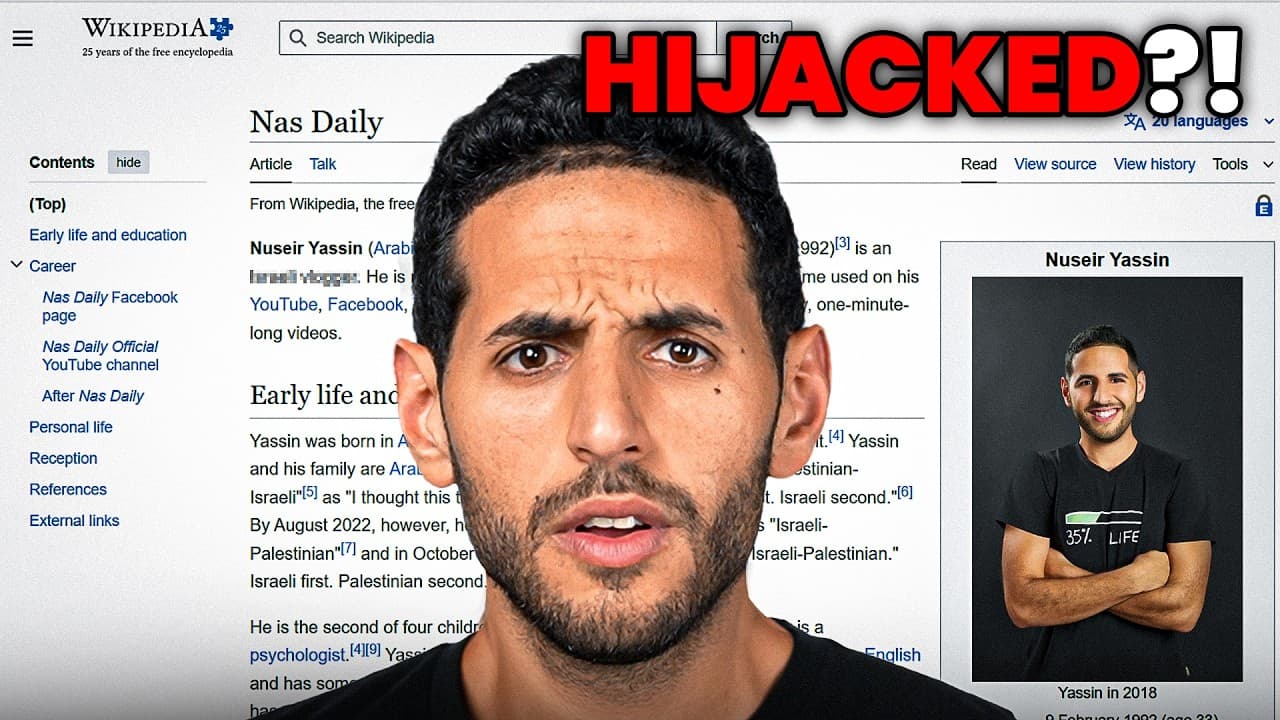
Nas Daily didn't log on one day to find his Wikipedia page slightly off. He found it systematically dismantled. According to My Wikipedia Got Stolen, ten anonymous editors coordinated to rewrite his article — removing the word 'Arab' from his description entirely, cutting any mention of his large following, and burying his entrepreneurial work. What remained was a portrait of a controversial Israeli content creator with a so-called 'normalizing agenda.' Not wrong in every detail. Just curated to land a specific way.
The editors then locked the page, which is where the damage compounds. Locking a Wikipedia article means no outside corrections can be made. His startup Nuse, which raised $40 million, isn't mentioned. His long-term relationship isn't there. Even the progress on his t-shirt sales — a minor detail, but one that signals how frozen the page is — was listed incorrectly. A locked page doesn't just preserve bias. It calcifies it. Related: JoJo's Bizarre Adventure: Netflix_anime_batch_release_strategy
The Loophole Nobody Talks About
Wikipedia's editing model is built on the assumption that a crowd of good-faith contributors will self-correct over time. That assumption breaks down the moment a small, coordinated group decides to camp on a single article. There's no requirement to use your real name. There's no accountability for what you remove. And once you've locked the page, the crowd can't get back in. The system designed to prevent vandalism becomes the tool that enables it.
Nas Daily points out this isn't unique to his page. Articles on politics, history, and race are, according to him, subject to the same pattern of motivated editing. He cites Wikipedia's own co-founder as a source of concern here — someone who helped build the platform and has since said publicly that it has moved away from genuine neutrality, now taking firm stances on issues where reasonable people disagree. That's not a fringe critique. That's the founder. Related: Huggbees Unpacks 'Tattooed Teenage Alien Fighters from Beverly Hills'
What Groqipedia Actually Does Differently
The alternative Nas Daily puts forward is Groqipedia, which he describes as an AI-powered answer to Wikipedia. Instead of relying on human editors, Groqipedia pulls from a wide range of online sources — videos, articles, social media — and uses AI to synthesize them into a summary. The article it generated about Nas Daily ran to 10,000 words and was, by his own assessment, about 95% accurate. When he flagged a factual error, the AI re-evaluated its sources and corrected it. No editor to convince. No locked page to fight. Just a system that updates when the evidence changes. Related: Harry Potter HBO Reboot Casting Controversy: Ben Shapiro's Take
Crucially, the Groqipedia article identified him as 'Israeli Arab' — the full description, not a politically trimmed version — and included both positive and negative coverage of his work. That's the baseline standard for any encyclopedia entry, and it's apparently easier for an AI to meet than for a room of anonymous human editors.
Our Analysis: Nas Daily's argument is strongest when it's specific — the locked page, the missing startup, the stripped identity — and weakest when it pivots to Groqipedia as the solution. He's essentially responding to 'anonymous humans manipulated my information' with 'trust this AI built by one of the most powerful and opinionated people on the internet.' The bias problem doesn't disappear because the editor is an algorithm. It shifts to whoever trained the model and chose the data sources. A 95% accuracy rate on a 10,000-word article still leaves 500 words of potential error, and unlike a Wikipedia page, you can't see the edit history.
The Wikipedia co-founder citation is the most credible thread in the video and also the least developed. That's the story worth pulling on — not one creator's page, but a platform that shaped a generation's understanding of history and politics quietly drifting from its founding principles. Nas Daily gestures at it and moves on. Someone should stay there longer.
There's also a structural tension worth naming: the same dynamics Nas Daily describes — a small group of motivated actors shaping what millions of people read as fact — apply far beyond Wikipedia. Search rankings, recommendation algorithms, and AI training data are all subject to similar capture. The difference is that Wikipedia at least makes its edit history public. You can trace exactly who changed what and when. That transparency, imperfect as it is, doesn't exist in most of the systems quietly replacing it. The solution to a flawed open system probably isn't a closed one with better PR.
Frequently Asked Questions
How do Wikipedia editors manipulate articles through Wikipedia bias and manipulation tactics?
Why does Wikipedia allow anonymous editors to lock pages and prevent corrections?
Is Wikipedia actually reliable for information on controversial political or identity topics?
What are the best alternatives to Wikipedia for accurate and unbiased information?
Can a Wikipedia page be rewritten to remove someone's ethnic or cultural identity?
Based on viewer questions and search trends. These answers reflect our editorial analysis. We may be wrong.
Source: Based on a video by Nas Daily — Watch original video
This article was created by NoTime2Watch's editorial team using AI-assisted research. All content includes substantial original analysis and is reviewed for accuracy before publication.