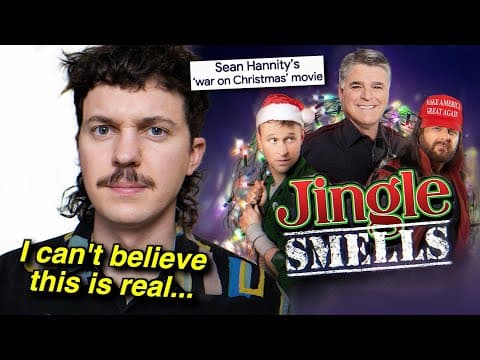
Jingle Smells Movie Review: Kurtis Conner's Take on Hannity's Film
Key Takeaways
- •Jingle Smells is executive produced by Sean Hannity and marketed as an anti-woke Christmas film, but its central cancel culture argument is undercut by its own ending, where the 'canceled' character Mason Stone is professionally restored after a CEO has an instant change of heart.
- •The film's protagonist Nick is a parolee whose police chief father repeatedly bends departmental rules to help him, a detail that sits awkwardly in a movie produced under a conservative banner that typically champions strict law enforcement.
- •Santa Claus exists in the film's universe but skipped children in low-income areas and hospitals during a snowstorm, leaving Nick to fill the gap, a plot point that raises more questions about Santa's moral priorities than it answers about woke culture.
Sean Hannity Made a Christmas Movie and It Shows
Jingle Smells arrives branded as the anti-woke antidote to whatever holiday content you've been watching. It is executive produced by Sean Hannity, a name that does a lot of work before a single frame of the film plays. In This Anti-Woke Christmas Movie is Awful, Kurtis Conner spends meaningful time establishing Hannity's background before engaging with the movie itself, and the portrait that emerges is of a producer whose involvement signals something specific about the film's intentions. This is not a Christmas movie that happens to have a political edge. It is a political product that happens to be set at Christmas, and the distinction matters for everything that follows.
Nick the Parolee and the Law Enforcement Problem
The film's protagonist, Nick, is introduced as a directionless ex-military parolee with no discernible plan and a very useful father. That father is a police chief. And that police chief, fairly early in the runtime, starts bending departmental rules to smooth the road for his son, including securing Nick a job in sanitation. Conner clocks this immediately, and it is genuinely hard to look past. A film produced under a conservative umbrella, one that would presumably align itself with pro-law-enforcement rhetoric, opens by showing a senior police official corrupting his position for personal reasons. Nobody in the movie treats this as a problem. It is played as fatherly love, which is a creative choice that tells you quite a bit about the film's relationship with the principles it claims to represent.
The Toy Company Logic Does Not Hold Up
Nick's path to becoming 'Jingle Smells' begins when he discovers that a major toy company is destroying its entire inventory of Mason Stone merchandise following Mason's cancellation. The company assigns exactly two garbage men to handle this disposal, which Conner flags as a logistical absurdity for what is supposedly a confidential corporate operation. Nick then decides to sell the toys rather than simply buy a more diverse range of gifts for the children he wants to help. It's the kind of plot architecture that only works if you don't ask a single follow-up question, and the film seems to be banking heavily on the audience not asking any.
A Conservative Film About Giving Stuff Away for Free
Once Nick commits to the 'Jingle Smells' persona and starts distributing toys to kids in need, Conner raises a point the film never addresses: the entire premise of a conservative-coded movie is that a guy dresses up to redistribute goods to low-income children and hospital patients. The charitable impulse at the heart of the story runs directly against the grain of political positions typically associated with the ideology the film is performing. Conner does not let this pass quietly. If you wanted to construct a narrative that accidentally argues for social welfare programs, you could not do much better than a vigilante Santa who shows up specifically because the system failed the people at the bottom. The movie seems completely unaware that this is what it made.
Santa Claus Skipped the Poor Kids and Nobody Mentions It
The film reveals mid-story that Santa Claus is real within this fictional universe. He did not deliver gifts to children in low-income areas or hospitals during the events of the movie because of a snowstorm. Nick fills the gap. Conner points out the obvious problem here, which is that this framing makes Santa a figure who, when conditions get difficult, deprioritizes the children who most need him. The movie introduces this detail to give Nick's mission stakes and legitimacy, but the implication it leaves hanging is that the magical being whose entire purpose is delivering gifts to children decided those particular children could wait. It is either a significant plot hole or an accidentally grim statement about who gets taken care of when things get hard.
The Ending Breaks the Movie's Own Argument
Jingle Smells builds its entire ideological case around the idea that cancel culture is an unstoppable, ruinous force. Mason Stone loses everything. The premise depends on the audience accepting that once you are canceled, you are finished. Then the film ends with a corporate CEO reversing the cancellation after what Conner describes as an essentially instantaneous change of heart, and Mason Stone's career is restored. The message the movie spent its entire runtime delivering is that cancel culture is a cultural catastrophe. The ending it chose demonstrates that cancel culture can be undone by one executive having a slightly different day. Conner gives the film a 1 out of 10, and based on the internal logic alone, it is difficult to mount a serious argument against that number. A movie that contradicts its own thesis in the final act is not a film with a message. It is a film that ran out of ideas and called it resolution.
Our Analysis: Kurtis nails the core absurdity here. A movie built around defending law enforcement stars a guy whose cop dad actively breaks the law to protect him. That's not a subtle contradiction, and the film doesn't seem to notice it exists.
What the video underplays is the Santa reveal. If Santa is real and chose to skip poor kids and sick kids during a snowstorm, the movie accidentally argues that charity fills gaps left by negligent institutions. That's closer to a progressive critique than a conservative one.
There's also a broader pattern worth naming. Conservative-coded entertainment has a recurring problem with internal consistency — not because the filmmakers are careless, but because the ideology being performed doesn't survive contact with narrative logic. The moment you put a character in a story, they need motivation, consequence, and coherent action. Abstract culture-war grievances don't translate cleanly into plot. Jingle Smells is a case study in what happens when a political talking point gets stretched into a third act: the seams show everywhere, and the ending has to betray the premise just to wrap up the runtime.
Hannity didn't make an anti-woke film. He made a self-own.
Frequently Asked Questions
Who made Jingle Smells and what is the movie about?
Does the Jingle Smells movie review by Kurtis Conner hold up — is the film actually that bad?
How does Jingle Smells handle its cancel culture message, and does the ending make sense?
Why does the Santa Claus detail in Jingle Smells cause such a plot problem?
Is the anti-woke Christmas movie Jingle Smells actually conservative in its values?
Based on viewer questions and search trends. These answers reflect our editorial analysis. We may be wrong.
Source: Based on a video by Kurtis Conner — Watch original video
This article was created by NoTime2Watch's editorial team using AI-assisted research. All content includes substantial original analysis and is reviewed for accuracy before publication.