Flat Feet Arch Strengthening Exercises: Dr. Berg's Solution
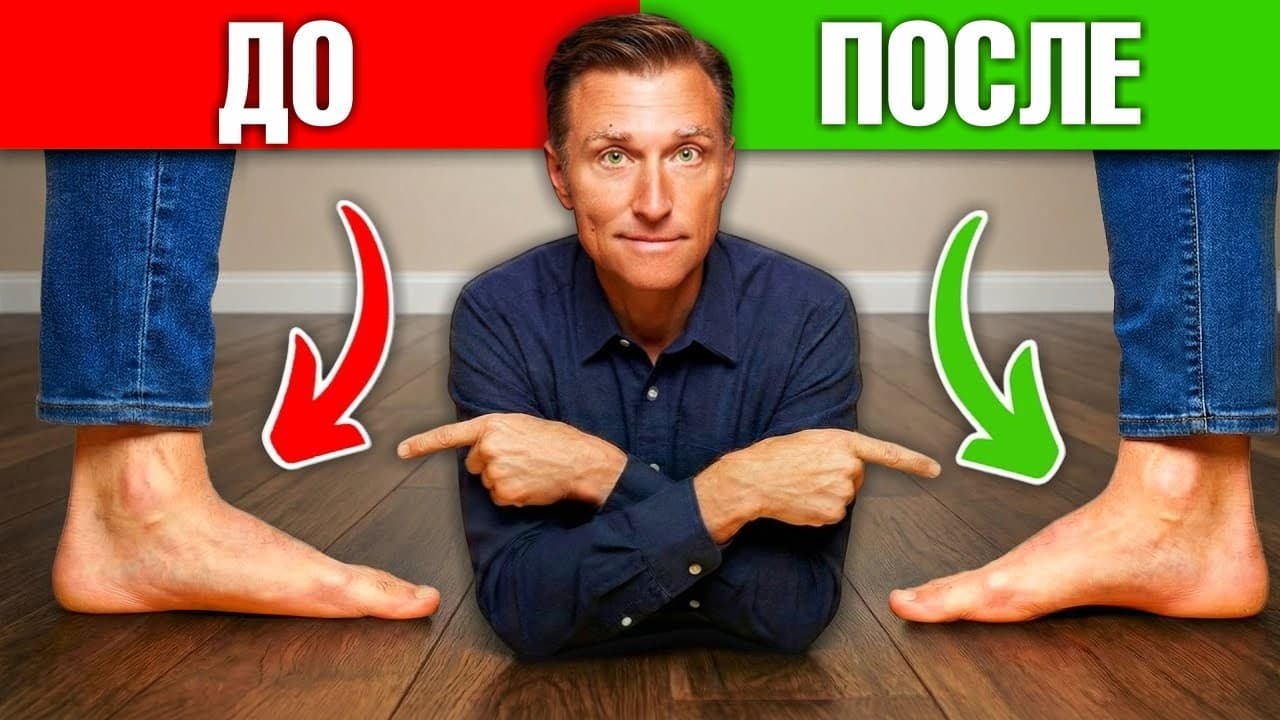
Key Takeaways
- •Most acquired flat feet are a muscle weakness problem, not a structural one — specifically the intrinsic foot muscles, including the abductor hallucis, that hold the arch up.
- •The arch doming exercise only works if your toes stay flat and relaxed on the ground — curling them activates the wrong muscles and defeats the whole point.
- •10–15 reps per foot, multiple times daily: consistency beats intensity here, and the payoff includes better balance and reduced knee and hip pain, not just a higher arch.
Your Flat Feet Are Probably a Muscle Problem
Here's something most people never hear from their podiatrist: a large portion of flat feet cases that develop over a person's lifetime aren't about bone structure at all. In his video Упражнение №1 для исправления плоскостопия🔥, Dr. Eric Berg draws a firm line between congenital flat feet — the kind you're born with — and the kind that creeps up on adults who spend years in supportive footwear, sitting at desks, and never once asking their intrinsic foot muscles to do any actual work. The second category, according to Berg, is highly treatable without surgery or orthotics.
The culprit is muscular underactivity. The intrinsic foot muscles — particularly the abductor hallucis, which runs along the inner edge of the foot — are supposed to act like a living cable, pulling the arch upward and holding it there. When those muscles weaken from disuse, the arch drops. The foot spreads. And then everything above it starts compensating in ways the body was never designed to sustain long-term. It's a more satisfying explanation than 'your arches just collapsed,' because it implies they can un-collapse.
The surprising part isn't the diagnosis — it's how small and overlooked the solution turns out to be.
Why the Foot Is Running the Whole Show
Berg frames the foot as the body's literal foundation, and the analogy holds up under scrutiny. When the arch flattens, the ankle rolls inward, the shin rotates, the knee tracks incorrectly, the hip compensates, and the lower back takes the slack. That's the kinetic chain doing what kinetic chains do — passing dysfunction upward until something loud enough starts hurting to get your attention. The foot itself often stays silent while your knees and hips absorb the consequences.
This is why people spend months treating knee pain that clears up only when someone finally looks at how their foot hits the ground. As we explored in Dr. Berg's breakdown of how the body compensates for internal imbalances, the root problem and the symptomatic problem are rarely in the same place. The body is excellent at redistributing stress. It's terrible at telling you where the stress originated.
The Abductor Hallucis: The Muscle You've Never Thought About
The abductor hallucis runs along the medial border of the foot — the inner edge, from the heel toward the big toe. Its job is to support the arch and stabilize the first ray of the foot during movement. In most modern humans, it is profoundly undertrained. Berg's argument is that reactivating this specific muscle, along with the surrounding intrinsic foot musculature, is the mechanism behind arch restoration. Not stretching. Not orthotics. Targeted, conscious contraction of muscles that have essentially gone dormant.
The anatomy here matters because the exercise only makes sense once you understand which muscle you're trying to reach — and why the more obvious movements, like toe curls, completely miss it.
The Arch Doming Exercise: How to Actually Do It
Sit in a chair. Feet flat on the floor, hip-width apart, toes pointing forward. Now — without curling your toes, without lifting your heel, without doing anything dramatic — try to lift the arch of your foot off the floor. The goal is a subtle doming effect: the inner part of the foot rises while the ball of the foot and the heel both stay grounded. Berg describes it as creating a 'dome' under the foot.
If you've never consciously tried to activate your foot arch before, there's a reasonable chance the first few attempts will feel like trying to wiggle an ear. The mind-muscle connection to intrinsic foot muscles is genuinely weak in most adults. That's not a failure — that's exactly the information gap this exercise is designed to close.
The rep range Berg suggests is 10–15 repetitions per foot, done multiple times throughout the day. Not once in the morning and forgotten. Multiple sessions, woven into existing routines — sitting at a desk, watching something, waiting for coffee to brew. The frequency matters more than the total volume.
Why Toe Curling Kills the Exercise
This is the piece that separates people who do this correctly from people who do it for three weeks and wonder why nothing changed. When you curl your toes to lift the arch, you're recruiting the flexor digitorum brevis and the extrinsic toe flexors — muscles that run from the lower leg down into the foot. They'll happily generate something that looks like an arch lift. But they're not the intrinsic muscles responsible for structural arch support, and training them doesn't transfer to the abductor hallucis or the other short foot muscles Berg is targeting.
Berg is emphatic on this point: toes flat, toes relaxed, toes entirely uninvolved. The contraction should be felt in the sole of the foot itself — a subtle but distinct tension along the arch. If your toes are gripping the floor, you've already lost the plot.
The Setup Mistakes Nobody Warns You About
Beyond toe curling, there are a few other ways this exercise quietly goes wrong. Letting the heel lift off the ground shifts the work to the calf and ankle complex — again, not the target. Tensing the entire foot rather than isolating the arch means you're just creating global foot stiffness, not specific muscle activation. And going through the motions too quickly — treating it as a count-to-fifteen situation rather than a feel-the-contraction situation — produces almost no useful adaptation. Slow, conscious reps where you're actually trying to sense the arch lifting beat fast, thoughtless ones by a significant margin.
Proper technique here is fiddly in a way that feels disproportionate to how small the movement is. That's actually the point.
What Consistency Builds Over Time
Berg is clear that this is not a quick fix. Intrinsic foot muscles that have been weak for years don't respond in a week. But the adaptation, when it comes, isn't just a visible arch — it's a change in how the foot functions during movement. The arch begins to engage automatically during walking and standing, rather than collapsing under load. The compensation chain that was quietly stressing the knees and hips starts to unwind.
There's also a less obvious benefit: proprioception. The intrinsic foot muscles are densely packed with mechanoreceptors — sensory structures that feed real-time position information to the nervous system. Strengthening these muscles improves the quality of that sensory signal, which translates to better balance, more stable landings, and reduced injury risk during any activity involving your feet. Which is most of them. As we noted in our look at how health interventions are often oversold, genuinely simple solutions with real physiological backing are worth taking seriously — this is one of them.
The Pain That Lives Above the Feet
Berg's broader argument — and the one with the most clinical relevance for people who've been treating symptoms without finding causes — is that correcting flat feet can resolve pain that has nothing to do with the feet themselves. Knee pain from inward rotation of the tibia. Hip pain from altered femoral tracking. Lower back pain from compensatory changes in pelvic tilt. All of these can trace a direct mechanical line back to a collapsed foot arch.
This doesn't mean every knee problem is a foot problem. But it does mean that if you've been cycling through knee treatments without sustainable improvement, and nobody has looked at your arch, you're missing a variable. The body's compensation patterns are logical — they make sense as short-term adaptations. The problem is that short-term adaptations become long-term structural loads, and those accumulate. Understanding how the body holds onto physical patterns gives some context for why these compensations don't just resolve on their own once the original problem is addressed.
Restoring the arch doesn't guarantee those secondary pains disappear — but the biomechanical logic for why they might is solid.
Our Analysis
Berg is doing something genuinely useful here, which is translating a principle that physical therapists have worked with for years — short foot exercises, intrinsic foot activation — into a format that a regular person can act on without equipment or a clinic visit. The arch doming exercise is not new. It's not a Berg invention. But most people have never heard of it, and the instruction to keep the toes flat is the key detail that separates useful explanation from useless vague advice about 'strengthening your feet.'
What the video doesn't address is the timeline. Berg says 'consistency is key' without giving people a realistic window for what to expect. Intrinsic foot muscle retraining typically takes weeks to months of regular practice before functional changes appear. Someone who tries this for two weeks and sees no visible arch change will likely quit — and they'd be quitting right before the neurological adaptation phase that actually matters.
The proprioception angle also deserves more attention than it gets. The foot's sensory function is underrated in general fitness conversation. People spend money on balance boards and stability training when the actual limiting factor is often how well their foot muscles are reading ground contact. Fix that, and balance improvements come as a side effect rather than a goal.
Overall verdict: the exercise works, the technique guidance is accurate, and the broader framing — that this is a muscle problem with a muscle solution — is more honest than the standard 'buy better orthotics' response. The missing piece is patience. This is a slow adaptation, and nobody should expect dramatic results fast.
Frequently Asked Questions
Can exercises really fix flat feet, or is surgery the only lasting solution?
How long does it take to strengthen a flat foot arch with exercises?
How do you do flat feet arch strengthening exercises without curling your toes?
Can flat feet actually cause knee and hip pain?
How do you build an arch in flat feet if you've had them your whole adult life?
Based on viewer questions and search trends. These answers reflect our editorial analysis. We may be wrong.
Source: Based on a video by Dr. Eric Berg — Watch original video
This article was created by NoTime2Watch's editorial team using AI-assisted research. All content includes substantial original analysis and is reviewed for accuracy before publication.