Quran Recitation Emotional Impact Conversions: Surah Al-Haqqah
Key Takeaways
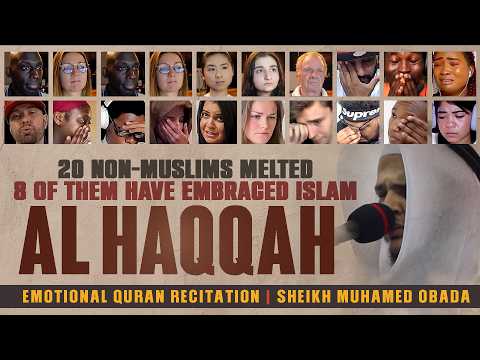
- •Eight of twenty non-Muslim reactors in the video later converted to Islam after encountering Quranic recitation — including a UK Christian (2023), a Dutch woman (2022), and a former Catholic (2020).
- •Sheikh Muhammad Obadah's recitation of Surah Al-Haqqah — recorded during congregational prayer — prompted emotional responses across religious backgrounds, including Buddhist, Christian, and atheist viewers.
- •Surah Al-Haqqah's themes of judgment day and accountability resonated with Christian reactors who noted parallels with biblical narratives, including the story of Pharaoh.
The Recitation That Keeps Stopping People Cold
Sheikh Muhammad Obadah's delivery of Surah Al-Haqqah wasn't recorded in a studio. It came from a congregational prayer — which matters, because there's no performance setup, no audience framing, no production artifice. What the reactors in this video encountered was a recitation made for worship, not for YouTube. And yet here it is, on YouTube, making people cry in their living rooms in the Netherlands and the UK.
Surah Al-Haqqah is not a gentle chapter. It deals with the Day of Judgment, with accountability, with what happens to those who rejected truth. The emotional weight isn't incidental to the content — it's inseparable from it. Several reactors described being hit by something they couldn't immediately name, reaching for words like "frequency" and "energy" before landing on simpler ones: calm, awe, peace. One reactor paused the video entirely just to collect herself. Another put on a headscarf mid-reaction, unprompted, out of what she described as respect. That's not a planned response. That's a reflex.
The Conversion Numbers Are the Real Story
The headline figure — eight out of twenty reactors converting to Islam — is the kind of statistic that sounds inflated until you meet the individuals behind it. In a recent video, Bayt of Us Global profiles three of them by name. Says She, a Christian woman from the UK, converted in 2023. Lis, from the Netherlands, recited her Shahada in 2022. Victor, a former Catholic, converted in 2020 — not impulsively, but after years of watching and reacting to Islamic content online.
These aren't snap decisions made in the heat of an emotional video. Victor's timeline alone spans years. What the recitation appears to do, based on these accounts, is open a door — the actual walking through it happens later, slowly, through study and reflection. That distinction matters if you're trying to understand what's actually happening here, rather than just being moved by it. For more on how spiritual encounters catalyse longer journeys, the pattern echoes what's documented in Jenny Joy's account of spiritual transformation — different tradition, same structure of a single moment that reorients everything that follows.
The Pharaoh Overlap
Several Christian reactors flagged something specific: the Quranic narrative of Pharaoh felt familiar. Not identical to what they knew from the Bible, but recognisably related — the same figure, the same arc of defiance and consequence. This kind of overlap tends to produce one of two reactions in people: suspicion (one borrowed from the other) or recognition (they're drawing from a shared well of ancient truth). The reactors in this video landed mostly in the second camp.
This is worth sitting with, because it's not a trivial observation. The Quran presents itself not as a correction of prior scriptures but as a continuation of the same divine communication — the same God, the same prophets, a renewed message. For Christian viewers encountering Quranic recitation for the first time, the Pharaoh story functions almost as a handshake. It says: you already know part of this. The reaction videos compiled here document that moment of recognition in real time, which is a different thing entirely from reading about interfaith overlap in an academic paper. If you're curious how similar dynamics play out with other Quranic chapters, twelve non-Muslims reacting to Surah Maryam covers comparable ground with a chapter that's even more explicitly tied to shared biblical figures.
Divine Word vs. Human Composition
The video makes a theological claim that runs underneath everything else: the Quran is not literature. It is not poetry in the conventional sense, not a novel, not the product of a gifted human writer. The evidence cited for this is the Prophet Muhammad's illiteracy — the argument being that a man who could not read or write could not have composed something of this linguistic and spiritual complexity. This is a classical Islamic argument, not a new one, but it lands differently when you watch someone encounter the recitation cold and describe being overwhelmed before they've understood a single word of Arabic.
That gap — between linguistic comprehension and emotional impact — is what the video keeps returning to. Reactors who speak no Arabic are moved before any translation is offered. The claim being made, implicitly, is that the effect precedes the meaning, which is either evidence of something genuinely beyond human craft or evidence that Sheikh Muhammad Obadah is an extraordinarily gifted reciter. The video is not interested in entertaining the second option. For readers curious about other claims of miraculous Quranic properties, the viral mathematical miracle arguments get a more sceptical treatment elsewhere on this site.
Our Analysis: The conversion stories are presented as outcomes of the recitation, but the video quietly skips the middle part — what happened between the emotional reaction and the Shahada. Victor's conversion took years. That gap is doing a lot of work that the video doesn't examine. Emotional impact and theological conviction are not the same thing, and collapsing them into a single narrative flattens what are clearly complex, individual journeys. The recitation may have been the catalyst, but it wasn't the whole story.
There's also something the video can't fully account for: the reactors who were moved but didn't convert. Twelve people out of twenty had profound emotional responses and did not embrace Islam. The video treats the eight conversions as the point. But the twelve are equally interesting — maybe more so. What did they feel, and where did it go? That question goes unasked.
There's a broader pattern worth naming here. Reaction content as a genre has quietly become one of the more effective formats for cross-cultural religious encounter — not because it's designed that way, but because the reactor's visible emotional processing gives viewers a proxy for their own potential response. You're not just watching the recitation; you're watching someone else be changed by it in real time. That's a fundamentally different experience from encountering religious content directly, and it almost certainly lowers the threshold for genuine engagement. Whether that's a feature or a complication depends on what you think authentic spiritual inquiry looks like. What's harder to dismiss is the sheer consistency of the emotional response across backgrounds — Christian, Buddhist, atheist — which suggests something in the recitation itself is doing work that transcends any single theological framework.
Frequently Asked Questions
Who is the number one Quran reciter in the world?
Does listening to Quran recitation actually lower cortisol or reduce stress?
What specific elements of Quranic recitation create such powerful emotional responses in non-Muslims?
Does the Quran say anything about forced conversions?
Based on viewer questions and search trends. These answers reflect our editorial analysis. We may be wrong.
Source: Based on a video by Bayt of Us Global — Watch original video
This article was created by NoTime2Watch's editorial team using AI-assisted research. All content includes substantial original analysis and is reviewed for accuracy before publication.