Water Filter Effectiveness Testing Contaminants Exposed
Key Takeaways
- •Project Farm's video 'Proof That Most Water Purifiers Don't Work!' puts over a dozen water filters through rigorous independent testing for copper, fluoride, and chlorine removal, revealing a stark gap between marketing claims and real-world performance.
- •Most pitcher filters, including popular names like Brita and Waterdrop, failed to meaningfully reduce copper and fluoride contamination, while only a handful of systems delivered reliable purification.
- •The Dreo reverse osmosis unit and Mega Home distiller topped the rankings, with ZeroWater emerging as the standout budget option for serious contaminant removal.
The Test That Exposes the Gap
Project Farm constructed a water sample spiked with 94 parts per million of copper, far above safe drinking levels, then ran it through every filter in the lineup under controlled conditions. Copper concentration, fluoride removal, chlorine clearance, and total dissolved solids were all measured independently. The point was not to confirm what manufacturers say on the box. The point was to find out what actually happens when contaminated water meets a filter you bought at Target. Most filters, it turns out, are much better at marketing than they are at chemistry.
The $16 Filter That Barely Tried
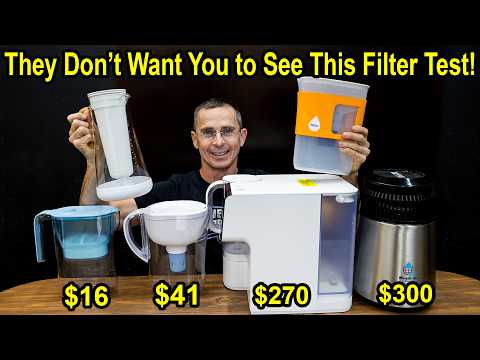
The Waterdrop filter, priced at $16, was the cheapest unit in the test and performed accordingly. Starting from that 94 ppm copper baseline, it managed to pull contamination down to 81 ppm, which is a reduction so marginal it barely registers as a win. Fluoride results were similarly unimpressive. The filter does move water through quickly, which is possibly the most honest thing that can be said about it. Speed and purification are not the same thing, and Waterdrop is a clean illustration of what you get when a filter optimizes for one at the expense of the other.
Where Mid-Range Filters Actually Land
PUR at $25 and Amazon Basics at $28 both outperformed Waterdrop on copper, bringing levels down to 1.89 ppm and 3.12 ppm respectively. Better, yes. Good enough, debatable. Brita, the brand most households default to, cost $41 and still left copper above 5 ppm in testing, which is a number that would make a toxicologist uncomfortable. LifeStraw at $52 was almost comically slow to filter but hit 0.03 ppm copper through its microfiltration membrane. Clearly Filtered at $100 matched that kind of performance at 0.05 ppm but filtered at a pace that tests your patience more than your water. The uncomfortable truth the video surfaces is that price and performance do not move in a straight line anywhere in the mid-range category.
ZeroWater Wins on Value and That's Not a Small Thing
At $34, ZeroWater uses a five-stage filtration system that includes ion exchange resin, and the results reflect that added complexity. Copper dropped to 0.07 ppm. Total dissolved solids hit zero. Fluoride removal was among the best of any pitcher tested. It is slower than simpler filters because it is doing significantly more work, and the filter cartridges need replacing more frequently because they are capturing more material. For consumers who want serious contaminant reduction without spending three hundred dollars on a countertop appliance, the video identifies ZeroWater as the obvious answer. The fact that a $34 pitcher outperforms a $41 Brita by this margin is the kind of data point that tends to travel.
Reverse Osmosis and Distillation Are Playing a Different Game
The Dreo reverse osmosis system at $270 and the Mega Home distiller at $300 did not just outperform the pitchers, they operated in a different category entirely. Both achieved zero parts per million for total dissolved solids. Both hit 0.04 ppm copper. Both cleared fluoride with the kind of efficiency that makes the mid-range pitcher results look like a rough draft. The distiller works by boiling water and condensing the vapor, physically separating contaminants from H2O at the molecular level. It is slow, producing two cups of water in roughly 41 minutes according to Proof That Most Water Purifiers Don't Work! by Project Farm. Reverse osmosis is faster and equally thorough. These are the systems you buy when you have genuinely contaminated source water and you are not interested in approximations.
Our Analysis: The chlorine finding is the sleeper result here. Every single filter passed. That tells you chlorine removal is essentially a solved problem, which means any brand still marketing chlorine removal as a premium feature is selling you a solved problem at an unsolved price.
The TDS meter trap is real and underreported. Marketers love that number because it sounds scientific and scares easily. Zero Water chases a TDS of zero, but pure water with zero dissolved solids is actually slightly aggressive on pipes and plumbing over time. Pristine readings are not always the goal.
What the Project Farm test also quietly confirms is how little the certification and marketing apparatus around consumer water filters correlates with actual outcomes. Brita has decades of brand equity and shelf dominance. It lost to a $34 ZeroWater on every metric that matters for contaminated water. That gap between reputation and performance is not a fluke — it reflects an industry where certification standards are often designed around the contaminants filters already remove well, not the ones that are genuinely difficult. Fluoride and heavy metals are the hard problems. The tests that matter are the ones that probe exactly those weak points, which is why independent testing like this carries more weight than the NSF badges on the packaging.
Frequently Asked Questions
Does water filter effectiveness testing for contaminants like fluoride and copper actually reflect everyday tap water conditions?
Do water filters actually remove fluoride, or is that mostly a marketing claim?
Is ZeroWater actually better than Brita for removing contaminants, or does it just score well on TDS?
Is a water distiller actually worth it compared to reverse osmosis, or are they basically the same?
Why does a slower water filter sometimes mean better filtration?
Based on viewer questions and search trends. These answers reflect our editorial analysis. We may be wrong.
Source: Based on a video by Project Farm — Watch original video
This article was created by NoTime2Watch's editorial team using AI-assisted research. All content includes substantial original analysis and is reviewed for accuracy before publication.