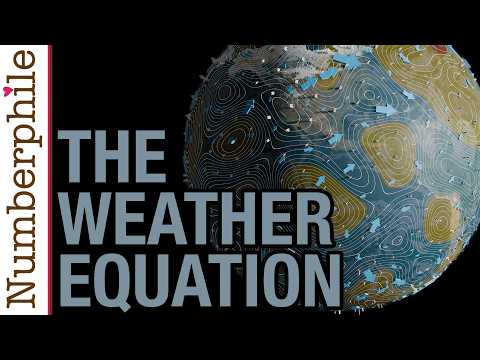
Quasi-Geostrophic Omega Equation Weather Explained
Key Takeaways
- •The quasi-geostrophic omega equation is one of meteorology's most important diagnostic tools, and Numberphile's video 'The Weather Equation - Numberphile' breaks down exactly why it matters.
- •Chief Meteorologist Dan Harris walks through how the equation allows forecasters to determine where air is rising or sinking in the atmosphere without ever measuring vertical wind directly.
- •The core problem is that vertical velocity is nearly impossible to measure reliably, so meteorologists instead derive it from horizontal airflow patterns, vorticity, and pressure gradients.
The Equation That Diagnoses Instead of Predicts
Most people assume weather equations are about the future. The quasi-geostrophic omega equation is about the present. As Numberphile's video The Weather Equation - Numberphile explains, this equation is a diagnostic tool — it takes what's happening horizontally in the atmosphere and works backward to figure out whether air is rising or sinking at a given location. That vertical motion is what drives the formation of low and high-pressure systems, the kind of systems that actually determine your weather. The equation is a simplified descendant of the full primitive equations used in early numerical forecasting models, stripped down enough to be analytically tractable without losing the physics that matters. For an equation that doesn't tell you what happens next, it has an enormous amount of influence over the field.
Why Nobody Measures Vertical Wind Directly
Omega, the Greek letter used in the equation, represents vertical velocity in a pressure-coordinate system rather than a height-based one. There's a practical reason pressure coordinates are preferred: pressure decreases monotonically with altitude, which makes the math of atmospheric modeling significantly cleaner. The alternative, using W in height coordinates, is technically equivalent but messier in practice. More importantly, direct measurement of vertical wind is unreliable. The vertical velocities involved are small, errors compound quickly, and deriving them from horizontal wind data introduces enough noise to make the results nearly useless. The entire framework of the omega equation exists, at least partly, because the thing it calculates is so hard to observe directly. There's something almost philosophically satisfying about a tool built specifically around a measurement gap. Related: Cold Fusion Scandal: Pons and Fleischmann's 1989 Claim
Vorticity Is the Spin Hidden in the Wind
Two types of vorticity appear inside the omega equation. Relative vorticity comes from local variations in airflow — the way wind shear across a region creates rotation. Planetary vorticity comes from Earth's rotation itself and varies with latitude. Together, they form what's called absolute vorticity, and the spatial gradient of this quantity, specifically how it's being transported by the wind (advection), is one of the primary forcing terms in the equation. Thermal advection, the movement of warm or cold air into a region, is the other. Forecasters who use this equation qualitatively are essentially asking: where is vorticity being imported, and where is warm air being dragged in? The answers point directly to where air is being forced upward. It sounds like reading tea leaves until you realize it's grounded in conservation laws that don't have exceptions.
Geostrophic Balance and Why Winds Don't Just Rush Inward
One of the cleaner conceptual pieces in the video is the explanation of geostrophic balance. When you look at a low-pressure system on a weather map, intuition says air should rush straight toward the center. It doesn't. Instead, winds blow roughly parallel to the isobars — the lines of equal pressure. This happens because the pressure gradient force, which does push air inward, is almost exactly balanced by the Coriolis force, an apparent force produced by Earth's rotation. The result is geostrophic wind: wind that flows parallel to isobars rather than across them. This balance ignores friction and acceleration, so it's an approximation, but it holds remarkably well for large-scale atmospheric flow away from the surface. The Coriolis effect gets a bad reputation as a quirky bathroom-sink myth, but at synoptic scales it is genuinely the dominant organizing force in the atmosphere. Related: Hobby Tunneling Safety Engineering: The Dangers of Digging
The Rossby Number Tells You When to Stop Trusting the Approximation
The Rossby number, developed by meteorologist Carl-Gustaf Rossby, is a dimensionless ratio that compares inertial acceleration to Coriolis acceleration. A small Rossby number, around 0.1 for large synoptic-scale weather systems, means the flow is strongly geostrophic and the approximation holds. A large Rossby number indicates that other forces are more dominant — as seen in phenomena like tropical cyclones, where the geostrophic framework breaks down entirely. This is why the quasi-geostrophic model works well for mid-latitude weather systems but fails for tropical cyclones. The quasi-geostrophic omega equation is not a universal tool. It is a precisely scoped one, and knowing its limits is as important as knowing what it can do. That kind of honest constraint is rarer in science communication than it should be. Related: Endocrine Disrupting Chemicals Health Effects: Dr. Shanna Swan
How the Equation Gets Used Without Being Solved
Here's the part that reframes everything. Forecasters don't sit down and plug numbers into the quasi-geostrophic omega equation. They look at weather maps and apply the equation's logic qualitatively. The left side of the equation contains omega — the thing you want to know. The right side contains forcing terms: vorticity advection, thermal advection. A forecaster reads the map, identifies regions of strong vorticity advection or warm air being transported into a column, and infers that ascent is likely there. It's pattern recognition backed by physics. This approach also sidesteps the divergence problem that makes pure geostrophic wind mathematically useless for explaining vertical motion — since geostrophic wind is non-divergent by definition, it can't directly drive air upward or downward, which is exactly why the quasi-geostrophic modification exists. The equation is less a calculation than a conceptual framework that disciplines how meteorologists read the atmosphere.
Our Analysis: The most quietly radical idea here is that pure geostrophic wind produces zero divergence, meaning the atmosphere's dominant wind pattern theoretically can't cause weather. Everything interesting happens in the residual, the small imperfections where reality refuses to behave.
Numberphile earns real credit for not flinching at the pressure-coordinate system. Most explainers quietly swap it out for something friendlier and lose the honest weirdness of omega being negative when air rises.
What goes unsaid is how forecasters navigate this daily using pattern recognition rather than calculation, trusting intuition built on equations they rarely write out. That gap between the math and the practice is the actual job.
There's also a broader lesson embedded in the Rossby number discussion that deserves more attention: science communication rarely emphasizes where a model breaks down, but the quasi-geostrophic framework's explicit failure at tropical scales is a feature, not a bug. Tools that know their own limits are more trustworthy than ones that don't, and that epistemological honesty is something the wider culture of forecasting could export to other fields.
Frequently Asked Questions
What is the quasi-geostrophic omega equation and why does it matter for weather forecasting?
Why can't meteorologists just measure vertical wind speed directly?
How does the Coriolis force stop winds from rushing straight into low-pressure systems?
Is vorticity advection really a reliable indicator of where air is rising in the atmosphere?
What is the Rossby number and how does it affect atmospheric modeling?
Based on viewer questions and search trends. These answers reflect our editorial analysis. We may be wrong.
Source: Based on a video by Numberphile — Watch original video
This article was created by NoTime2Watch's editorial team using AI-assisted research. All content includes substantial original analysis and is reviewed for accuracy before publication.