Project Plowshare Nuclear Excavation: Cold War Atomic Dreams
Key Takeaways
- •Project Plowshare was a Cold War-era U.S.
- •government initiative that attempted to repurpose nuclear weapons as civilian engineering tools, proposing to detonate hundreds of nuclear bombs to dig canals, construct harbors, and reshape landscapes on an industrial scale.
- •Conceived by physicist Edward Teller and active for roughly two decades, the program never built a single canal or harbor, and was cancelled in 1977 after tests revealed catastrophic miscalculations about radioactive fallout and environmental contamination.
What Was Project Plowshare
Somewhere in the mid-20th century, a group of serious, credentialed scientists looked at nuclear weapons and thought: what if we just aimed them at the ground and called it infrastructure? That was the premise of Project Plowshare, a United States government program that sought to use nuclear explosives for large-scale civilian engineering. The pitch was to detonate bombs underground to excavate canals, reshape coastlines, and build harbors faster and cheaper than conventional methods ever could. It sounds like a fever dream, but it had a budget, a scientific staff, and the backing of some of the most prominent physicists of the era. As Kurzgesagt lays out in The Most Insane Megaproject You Never Heard About, this was not fringe science. It was official U.S. policy.
Edward Teller and the Logic of Peaceful Explosions
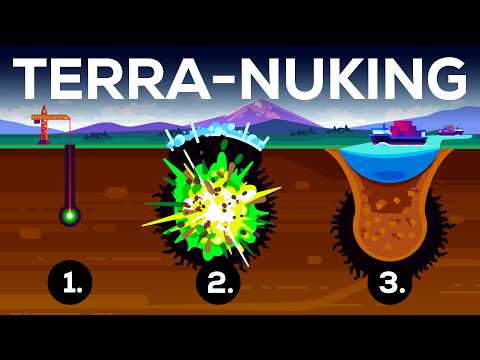
The architect of Project Plowshare nuclear excavation theory was Edward Teller, one of the key figures behind the hydrogen bomb. Teller believed thermonuclear devices could function as precision engineering tools, proposing a method where explosions detonated deep underground would convert surrounding rock into molten material, which would then collapse inward and theoretically seal radioactive debris beneath the surface. The fallout, in his model, would stay put. The crater would be clean enough to use. It was an elegant theory, with one problem that would take twenty years and multiple disasters to fully acknowledge: nuclear explosions do not negotiate. The confidence Teller brought to this idea, given what the tests eventually showed, is the kind of thing that makes you rethink how much weight to give any expert who has never been proven wrong yet.
The Pan-Atomic Canal Nobody Talks About
The crown jewel of Plowshare's ambitions was a proposed Panama Canal replacement that would be carved out using roughly 250 nuclear devices. Engineers and scientists extensively modeled the project, concluding it would be dramatically cheaper than conventional excavation. What the models also showed, though planners were slower to advertise this part, was that the blasts would require evacuating tens of thousands of people, and that radioactive fallout would spread across vast distances, affecting ecosystems and populations far outside the blast zones. Neighboring countries would absorb shockwaves. The ecological disruption would not be local. The plan was detailed enough to be taken seriously and dangerous enough that it is genuinely alarming it got that far.
When the Tests Stopped Cooperating
Project Gnome was one of Plowshare's first real-world tests, designed to create an underground cavity that could theoretically be used for power generation. It produced instead a massive steam plume laced with radiation that vented directly into the open air. The Sedan test, intended to demonstrate controlled crater creation, scattered radioactive fallout across multiple U.S. states. These were not minor miscalibrations. They were fundamental failures of the underlying model. The gap between what Teller's containment theory predicted and what actually happened in the Nevada desert was not a rounding error. It was the difference between a controlled engineering process and an uncontrolled radiological event, and the distinction matters quite a bit when you are talking about detonating 250 of these across Central America. If you want a parallel for how quickly institutional confidence can lag behind empirical evidence, the story of The Most Insane Megaproject You Never Heard About is a useful place to start.
Our Analysis: Kurzgesagt nails the absurdity but buries the most chilling part. Project Plowshare wasn't a fringe idea from reckless cowboys. It had serious institutional backing, peer-reviewed support, and a budget. That's the real story.
The video frames this as a cautionary tale about miscalculation. But the miscalculation wasn't technical. Scientists knew the contamination risks early. The project kept going anyway because it served a political purpose that had nothing to do with canals.
The question worth sitting with is how many current megaprojects follow the same logic, where the stated goal is a costume for something else entirely.
Frequently Asked Questions
What was Project Plowshare nuclear excavation and why did it fail?
How many nuclear bombs were proposed for the Pan-Atomic Canal to replace the Panama Canal?
What happened during the Sedan nuclear test and how bad was the fallout?
Why did Edward Teller think nuclear explosions could be used as safe engineering tools?
Could peaceful nuclear explosives ever realistically be used for construction today?
Based on viewer questions and search trends. These answers reflect our editorial analysis. We may be wrong.
Source: Based on a video by Kurzgesagt — Watch original video
This article was created by NoTime2Watch's editorial team using AI-assisted research. All content includes substantial original analysis and is reviewed for accuracy before publication.