Newcomb's Paradox: Why Smart Minds Disagree 50/50
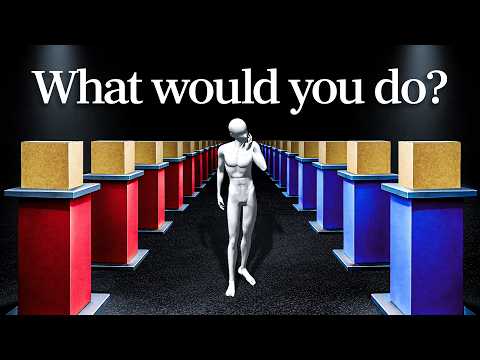
Key Takeaways
- •A thought experiment called Newcomb's Paradox splits smart people straight down the middle — and nobody can agree who's right.
- •Veritasium's Derek Muller breaks down the paradox in 'This Paradox Splits Smart People 50/50,' exploring why two completely opposite strategies can both seem like the rational choice.
- •The setup involves a supercomputer that predicts your decisions with near-perfect accuracy, a mystery box, and $1,000 in cash sitting right there for the taking.
What Is Newcomb's Paradox?
Newcomb's Paradox decision theory is one of those problems that sounds simple until you try to answer it, then suddenly you're arguing with a philosopher at 2am.
A supercomputer — highly accurate, long track record — has already predicted what you're going to do and set up two boxes accordingly.
The Two-Box Setup and the Supercomputer's Role
Box A is open: $1,000 cash, yours no matter what. Box B is sealed: either $1 million or nothing, depending on what the computer predicted you'd choose.
If the computer predicted you'd take only Box B, there's a million inside. If it predicted you'd grab both, Box B is empty. The computer already made its call. You just have to live with it.
One-Boxers vs Two-Boxers: The Great Divide
Ask a room full of smart people what to do and it splits almost exactly in half, which is the part that should make you nervous.
The One-Boxer Argument: Evidential Decision Theory
One-boxers follow Evidential Decision Theory, which says: look at the evidence. The computer is almost never wrong. Every person who's grabbed just the mystery box has walked away with a million dollars.
Your choice, in this framework, is strong evidence of what's inside the box — so choose the action that correlates with the outcome you want.
The Two-Boxer Argument: Causal Decision Theory
Two-boxers think that's wishful thinking. Causal Decision Theory says your current choice cannot reach back in time and change what the computer already put in that box.
The million is either there or it isn't. Taking Box A adds $1,000 with zero downside. That's called a dominant strategy, and dismissing it because of a prediction feels, to two-boxers, like magical thinking.
Why the Paradox Splits Rational People
Both sides are being rational — they're just using different definitions of the word, which is the actual problem here.
Evidential decision theorists ask: given my choice, what outcome should I expect? Causal decision theorists ask: given what's already fixed, what action produces the best result? Same paradox, completely different answers.
There's a brutal counterpoint to the two-boxer position known as the 'Why Ain'cha Rich?' argument — one-boxers consistently walk away with more money, which is a hard thing to argue with.
The Free Will Implications of Newcomb's Paradox
If a computer can predict your choice with near-perfect accuracy, that nudges uncomfortably close to predetermination.
In This Paradox Splits Smart People 50/50, Veritasium points out that even if free will turns out to be an illusion, Newcomb's Problem forces the question of whether a 'free' choice means anything at all when someone already knows what you'll pick.
Pre-Commitment as a Winning Strategy
One way out of the paradox is to not be in it. If you can credibly commit — before the computer runs its prediction — to only ever taking one box, the computer predicts accordingly and the million is guaranteed.
This reframes rationality entirely: instead of optimizing each decision in isolation, the smarter move might be choosing rules to live by and sticking to them.
Newcomb's Paradox vs Prisoner's Dilemma
The same logic shows up in the Prisoner's Dilemma, where committing to a strategy in advance changes what other players — or predictors — expect from you.
In both cases, the person who locks in a principle early often ends up better off than the one calculating every move fresh.
What Newcomb's Paradox Reveals About Rational Behavior
Newcomb's Problem doesn't have a consensus answer — and that's the point Derek Muller is making.
Rationality isn't one thing. It's at least two competing frameworks that produce opposite instructions, and the paradox is a clean stress-test for which one you actually trust.
Our Analysis: Veritasium frames this well, but buries the real insight — this isn't just a puzzle about boxes, it's about whether rationality should be evaluated per-decision or across a lifetime of decisions.
This connects to a broader shift in behavioral economics and AI alignment: the growing consensus that rule-based agents often outperform case-by-case optimizers, even when the rules look locally irrational.
The forward-looking angle nobody mentions: as prediction algorithms get better, Newcomb-style dilemmas stop being thought experiments and start showing up in credit scoring, hiring, and criminal justice.
Source: Based on a video by Veritasium — Watch original video
This article was created by NoTime2Watch's editorial team using AI-assisted research. All content includes substantial original analysis and is reviewed for accuracy before publication.