Cosmic Voids: The Scariest Places in Our Universe
Key Takeaways
- •Most of the universe is nothing — and that nothing is winning.
- •Kurzgesagt's latest video, "This Is the Scariest Place in The Universe," breaks down how cosmic voids, the vast near-empty regions that dominate the universe's volume, are not passive gaps but active structures driven by dark energy that are slowly swallowing the cosmic web whole.
- •Scientists have catalogued over 8,000 of these voids so far, some stretching nearly 300 million light-years across.
What Are Cosmic Voids in the Universe?
Cosmic voids are colossal bubbles of near-nothingness — regions spanning hundreds of millions of light-years that contain almost no galaxies, no stars, and barely any ordinary matter.
They are not simply where stuff isn't. In This Is the Scariest Place in The Universe, Kurzgesagt argues they "actively shape the structure of everything around them" — growing, colliding, and hollowing themselves out further over cosmic time.
The Scale and Composition of Universal Voids
Scientists have identified more than 8,000 cosmic voids so far, and the count keeps climbing — each new discovery tends to be larger than what came before.
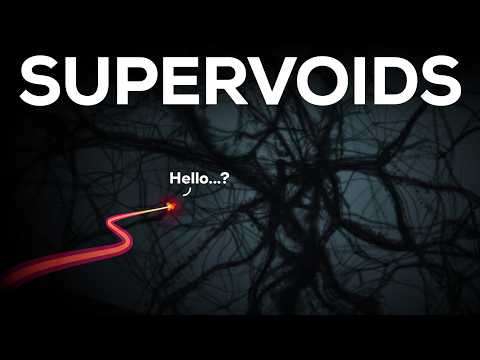
The Boötes Supervoid, one of the most studied examples, stretches close to 300 million light-years wide. Faint dark matter filaments thread through the interior, but actual galaxies are almost nowhere to be found.
The Cosmic Web: How Galaxies Cluster Around Voids
Zoom out far enough and the universe looks like a sponge — or a spider's web after a very bad week. Galaxies, gas, and dark matter clump along filaments and flat sheets, forming the cosmic web, and the spaces between those filaments are the voids.
Earlier models assumed matter was spread roughly evenly across space. The cosmic web buried that idea.
Why Galaxies Rarely Enter Voids
You might expect galaxies to drift in and fill the empty space over time. They don't.
The mass inside a void is so sparse that the gravitational pull from the surrounding dense cosmic web wins every time, dragging matter outward toward the filaments and making voids progressively emptier as the universe ages.
Void Galaxies: Isolated Worlds in Empty Space
The rare galaxies that do exist inside voids live completely different lives from their counterparts in crowded galaxy clusters.
No mergers, no collisions, no neighbours stealing their gas. Just slow, quiet evolution on their own.
Unique Characteristics of Void Galaxy Evolution
Void galaxies tend to be smaller and bluer, and they keep forming new stars at a gentle, sustained pace rather than burning through their fuel in violent bursts triggered by galactic pile-ups.
Kurzgesagt raises the possibility that these isolated systems could become the last refuges for any civilizations still around in the far future — the universe's final habitable addresses, long after the rest of the cosmic web has gone dark and cold.
Dark Energy's Role in Expanding Cosmic Voids
Dark energy, the force accelerating the expansion of space, is hard to detect where gravity is strong. Inside voids, there is almost nothing pushing back — which makes them the one place where dark energy's effects are most visible.
Space inside a void is being stretched right now, faster than in denser regions.
How Dark Energy Dominates in Low-Density Regions
In galaxy clusters, gravity keeps things bound together despite the expansion. In voids, there is no such counterweight, so dark energy runs unchecked, visibly pulling the walls of the void outward and thinning the filaments of the cosmic web over time.
The supervoids are not static. They are eating.
The Ultimate Fate of the Universe: A Universe of Voids
In the far, far future — timescales that make the current age of the universe look like a rounding error — this process does not stop.
The cosmic web gradually comes apart as supervoids expand and merge, filaments stretch too thin to hold, and superclusters dissolve into background noise.
When Supervoids Consume the Observable Universe
Kurzgesagt's projection is bleak in a beautiful way: the entire observable universe eventually becomes one vast, singular void.
The cosmic voids universe began as the space between things. It ends as everything.
Our Analysis: Kurzgesagt nails the counterintuitive weirdness of voids — they're not just empty space, they're active structures that reshape galaxies. The "scariest place" framing is a bit dramatic, but the underlying physics is solid and rarely explained this accessibly.
This connects to a broader shift in cosmology: voids are becoming serious scientific tools, not afterthoughts. Researchers are using them to probe dark energy more cleanly than galaxy clusters allow, precisely because there's less noise.
The long-term take is genuinely unsettling — as dark energy accelerates expansion, voids win. Most of the observable universe eventually becomes one.
Frequently Asked Questions
Why do cosmic voids exist in the first place — did something create them?
Could a civilisation actually survive inside a void galaxy long-term, or is Kurzgesagt just being dramatic?
What is the biggest cosmic void we have actually found?
If dark energy is invisible everywhere else, how exactly do scientists measure its effects inside voids?
Is the universe really going to become one giant void, or is that just a worst-case scenario?
Based on viewer questions and search trends. These answers reflect our editorial analysis. We may be wrong.
Source: Based on a video by Kurzgesagt — Watch original video
This article was created by NoTime2Watch's editorial team using AI-assisted research. All content includes substantial original analysis and is reviewed for accuracy before publication.