Concern Over Hexane in Seed Oils Safety: A Deep Dive
Key Takeaways
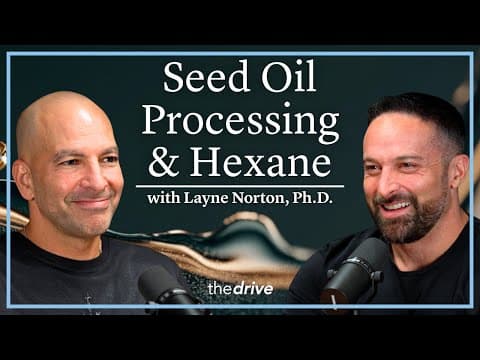
- •In a discussion on The Drive Podcast, Peter Attia and guest Layne Norton, Ph.D.
- •examine whether the industrial processing of seed oils, specifically the use of hexane as a chemical solvent, poses a genuine health risk to consumers.
- •The conversation tackles the fear head-on by running the actual toxicology numbers: hexane residue in finished oils typically falls below one part per million, the primary danger from hexane is inhalation not ingestion, and a person would need to consume over 11,000 kilograms of oil to reach even mild toxicity thresholds.
Why Factories Use Hexane in the First Place
Seed oils like corn oil do not flow freely out of the source material on their own. Getting meaningful yield requires either pressing the raw material under mechanical force or soaking it in a solvent that pulls the oil out chemically. As Peter Attia and Layne Norton discuss, the solvent route wins commercially every time because it extracts more oil at lower cost. Hexane is the solvent of choice for a straightforward reason: it is nonpolar, which means it mixes readily with nonpolar fats, and its boiling point sits at around 69 degrees Celsius, low enough that it can be driven off with steam relatively quickly. The crude oil separates, the hexane evaporates, and what remains goes through further refining. The industrial logic is clean even if the process itself sounds alarming to people who have never thought about where their cooking oil actually comes from.
What Actually Stays in the Bottle
The obvious follow-up question is how much hexane survives all that steaming and refining. According to the discussion between Attia and Norton, the answer is very little. Finished oils typically contain hexane levels below one part per million, and many samples test as undetectable by current instruments. The temperatures used during hexane removal are also worth understanding: the steam processing runs at roughly the boiling point of hexane, which is far below the 200 degrees Celsius or more that would be needed to cause meaningful oxidation of the oil itself. So the processing step that worries people is not hot enough, long enough, to create the oxidation problem they are worried about. One part per million is not zero, but it is also the kind of number that tends to lose its menace once you put it next to something with actual scale.
The 11,000 Kilogram Problem
Norton ran the numbers on what it would actually take to experience hexane toxicity through dietary intake, and the figure is almost comedically large. Based on rodent study data requiring extremely high doses to produce even mild effects, the estimated amount of seed oil a person would need to consume to hit a relevant hexane threshold is over 11,000 kilograms. That is not a lifetime figure with some plausible cumulative logic attached. That is the quantity needed to see effects at all. The conversation in Is Industrial Processing the Real Problem With Seed Oils? | Layne Norton, Ph.D. is careful to distinguish between what the data shows and what the fear assumes, and on this particular metric, the data is not subtle. This is the kind of number that should probably end the hexane conversation, but won't, because the fear was never really grounded in the numbers to begin with.
Inhalation vs. Ingestion — A Distinction That Actually Matters
The cases of genuine hexane toxicity that exist in the medical literature overwhelmingly involve workers with chronic, high-level inhalation exposure, not people eating food. Norton points out that the biological pathway for hexane harm is through the lungs, not the gut, and that the body handles ingested trace amounts through normal metabolic processing and elimination. Unlike compounds that persist at steady concentrations in circulation, hexane does not bioaccumulate. The body clears it. This matters because the chronic exposure argument, the one that says even small amounts add up over years, depends on the substance staying in the system long enough to cause cumulative damage. Hexane does not do that, and as someone who has read a lot of health content that skips this distinction entirely, it is refreshing to hear it stated plainly. Peter Attia's research-forward approach to these questions, which you can also see in his work on Is Industrial Processing the Real Problem With Seed Oils? | Layne Norton, Ph.D., consistently prioritizes mechanism over narrative — and on hexane, the mechanism simply does not support the alarm.
Our Analysis: Norton and Attia do solid work dismantling the hexane panic. The math alone should end that particular argument. If you need 11,000 kg of oil to register a problem, hexane residue is not your issue.
What they gloss over is the more uncomfortable question. Linoleic acid tripling in the food supply over a century is not a small variable to wave away. That trend deserves harder scrutiny than it gets here, and framing it as probably fine because the acute toxicity data looks clean is the weakest part of an otherwise rigorous conversation.
Frequently Asked Questions
Is hexane in seed oils actually a safety risk?
How much hexane residue is actually left in cooking oil after processing?
Why is hexane used in seed oil extraction instead of mechanical pressing?
Can your body accumulate hexane from eating seed oils over time?
Does the way seed oils are processed with hexane cause oxidation in the oil?
Based on viewer questions and search trends. These answers reflect our editorial analysis. We may be wrong.
Source: Based on a video by Peter Attia — Watch original video
This article was created by NoTime2Watch's editorial team using AI-assisted research. All content includes substantial original analysis and is reviewed for accuracy before publication.