Heavy Metals in Sea Salt Brands: Shocking Test Results
Key Takeaways
- •Celtic Sea Salt — widely trusted in health communities — tested worst, with high levels of lead, arsenic, and aluminum.
- •Diamond Kosher Salt tested clean across all categories: no heavy metals, no microplastics, and it's one of the cheapest options available.
- •Lead has no safe consumption threshold — it accumulates in the body over time, making even small daily exposures from salt a legitimate concern.
Heavy Metal Contamination in Popular Salt Brands
Lead Levels in Sea Salt: What the Testing Revealed
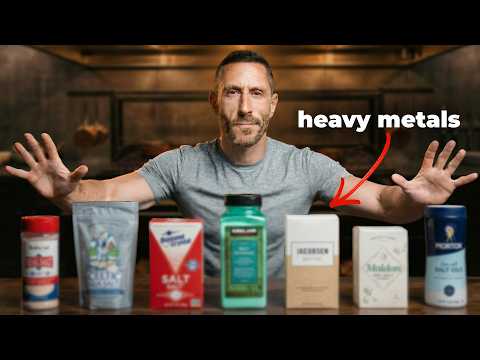
One of the salts tested — according to Paul Saladino's I Tested the Top 7 Salts for Toxins (Only 2 Passed) — came back with lead levels five times higher than California's Prop 65 limit. That's the threshold California uses to trigger mandatory warning labels on consumer products. Redmond Real Salt, a brand with a loyal following among people who specifically care about what they put in their bodies, showed high readings for both lead and aluminum. Kirkland Sea Salt registered the highest aluminum levels of any brand tested. Lead is the one that should keep you up at night — there is no established safe level of consumption, it accumulates in tissue over time, and the effects on brain and kidney function are well documented. The fact that it's showing up in a product people use multiple times a day is the kind of slow-drip exposure that's easy to dismiss until it isn't.
Microplastics Found in Common Table Salts
Two salts — Maldon and Jacobson — cleared the heavy metals bar entirely but still failed on microplastics. Both are premium products, the kind you'd find in a specialty grocery store or on a food enthusiast's shelf. Microplastics in salt aren't a new finding; researchers have been flagging ocean-sourced salts for years given how thoroughly plastics have infiltrated marine environments. What's notable here is that the contamination showed up in salts that otherwise looked clean, which means passing one test doesn't mean passing all of them. If you're trying to minimise total toxin load, you need a salt that clears both hurdles simultaneously — and most of the brands tested didn't.
Salt Brand Rankings: Which Salts Passed the Test
Why Celtic Sea Salt Ranked Worst Despite Health Claims
Celtic Sea Salt has built its reputation on being unprocessed and mineral-rich — the implicit promise being that less industrial intervention equals better for you. The test results don't support that story. It came back with measurable levels of lead, arsenic, and aluminum, making it the worst performer across all seven brands. Arsenic has a well-established link to cancer risk. Aluminum has been associated with cognitive decline, though the research is more contested. Lead, again, has no safe floor. The irony is that the very thing Celtic Sea Salt markets as a feature — its raw, unrefined character — may be exactly why it's picking up contaminants. Unprocessed doesn't automatically mean uncontaminated, and this is a case where the health branding is running well ahead of the actual safety profile. That a product sold specifically to health-conscious consumers turned out to be the most contaminated of the bunch is the kind of finding that should make anyone rethink how they evaluate 'natural' food claims.
Diamond Kosher Salt: The Clean Alternative
Diamond Kosher Salt is not glamorous. It doesn't come in a grey linen pouch or carry a story about ancient sea beds. It's a standard supermarket product, usually stacked near the bottom shelf, and it costs very little. In Saladino's testing, it returned zero detectable heavy metals and zero microplastics — the only brand to clear both categories entirely. Morton Iodized Salt also came back relatively clean on heavy metals but contains additives that some people prefer to avoid. Diamond Kosher had neither the contaminants nor the additives. The lesson here isn't complicated: the expensive, artisanal option lost to the cheap, boring one on every metric that actually matters for safety. That's not a satisfying conclusion for anyone who's been paying a premium for 'cleaner' salt, but it's what the data showed.
How to Choose Non-Toxic Salt for Your Kitchen
The practical takeaway from this testing is straightforward. Look for a salt that has been independently tested for both heavy metals and microplastics — not just one or the other. Marketing language like 'raw,' 'natural,' 'mineral-rich,' or 'hand-harvested' tells you nothing about contaminant levels. If anything, this data suggests those descriptors correlate with higher contamination, not lower. Diamond Kosher Salt is the specific recommendation here based on the test results. If you're concerned about broader dietary toxin exposure — and given how frequently salt is used, it's a reasonable thing to be concerned about — it's also worth thinking about other daily staples in the same way. The same logic that applies to how we evaluate ultra-processed food research applies here: the label on the front of the package is not evidence. Third-party testing is. And if you're already paying attention to micronutrient gaps in your diet, it's worth knowing that contamination isn't the only hidden variable — deficiencies like those covered in vitamin B1 deficiency symptoms can also fly under the radar for years before becoming obvious.
The most useful thing this video does is break the mental shortcut that 'less processed equals safer.' Celtic Sea Salt's results are a direct challenge to a heuristic that a lot of health-conscious people rely on across multiple food categories — not just salt. If unrefined, mineral-rich, hand-harvested salt can carry lead levels that would trigger a Prop 65 warning label, the same scrutiny probably applies to other products wearing similar branding.
What the video doesn't address is where the contamination is actually coming from — whether it's the source water, the harvesting environment, or the processing equipment. That matters because it would tell you whether the problem is fixable or structural. Without that, the recommendation to switch to Diamond Kosher Salt is solid advice, but it's advice without a mechanism, and the mechanism is what would let you generalise the lesson to other products.
There's also a broader industry question worth sitting with: if brands like Celtic Sea Salt and Redmond Real Salt have built substantial businesses on the premise that unprocessed equals pure, and third-party testing undermines that premise, the burden of proof has quietly shifted. It's no longer enough to tell a good origin story. Consumers who take their health seriously are going to start expecting published test results as a baseline, not a differentiator. The brands that get ahead of that shift — proactively testing and publishing data — will be better positioned than those that keep leaning on heritage marketing. Diamond Kosher Salt didn't win this comparison because it tried to; it won because the testing happened to catch everyone else out.
Frequently Asked Questions
Which sea salt has no heavy metals?
Which salt has the most heavy metals?
What is the healthiest sea salt to use for everyday cooking?
Does pink Himalayan salt contain heavy metals?
Does 'natural' or 'unrefined' salt actually mean it's safer?
Based on viewer questions and search trends. These answers reflect our editorial analysis. We may be wrong.
Source: Based on a video by Paul Saladino — Watch original video
This article was created by NoTime2Watch's editorial team using AI-assisted research. All content includes substantial original analysis and is reviewed for accuracy before publication.