Mark Tilbury: S&P 500 Concentration Risk AI Bubble Warning
Key Takeaways
- •Mark Tilbury, a seasoned investor with over 35 years of experience, says he is actively changing how he allocates his money because of AI's growing grip on the S&P 500.
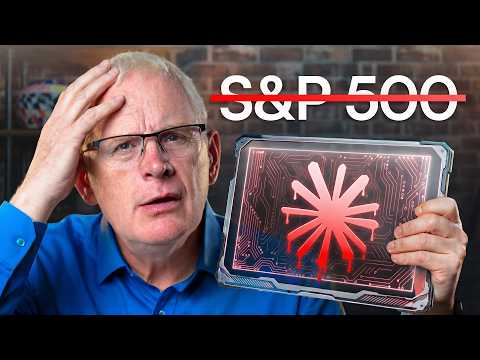
- •In his video 'I'm Changing How I Invest My Money Because of AI,' Tilbury argues that nearly 40% of the S&P 500 is now concentrated in just ten companies, most of them tech giants whose valuations are built on future AI revenue rather than current profits.
- •His concern is structural: passive investing in a market-cap-weighted index no longer means broad diversification.
Ten Companies Are Basically Running the S&P 500 Now
The S&P 500 is a market-cap-weighted index, which means the biggest companies get the biggest slice of every dollar you invest. That has always been true. What has changed is the degree. According to Mark Tilbury, roughly 40% of the entire index is now concentrated in just ten companies, and almost all of them are deeply committed to AI development, carrying the valuations to prove it. In I'm Changing How I Invest My Money Because of AI, Tilbury makes the case that when you buy a passive S&P 500 fund today, you are not buying 500 companies with roughly equal influence over your returns. You are mostly buying a handful of tech giants and hoping the AI revolution goes exactly as planned. That is a very different risk profile than most passive investors signed up for.
The Valuation Problem Nobody Wants to Talk About
Here is the uncomfortable part. The prices on these AI-centric companies are not being justified by what they earn right now. They are being justified by what investors expect AI to earn for them years from now. Tilbury points out that these firms are taking on significant debt to fund AI infrastructure buildout, and the market is essentially pricing in a future where that spending pays off enormously. Meanwhile, passive investment flows keep arriving automatically every month, pushing prices higher regardless of whether the underlying business results are catching up to the projections. It is a self-reinforcing loop, and the question of whether it ends gracefully or badly is one nobody can answer with any confidence. For context on what happens when speculative cycles hit a wall, the history of the dot-com era is instructive — and worth keeping in mind as AI valuations continue to stretch.
Our Analysis: Tilbury gets the core right. The S&P 500 is quietly a leveraged AI bet whether you want it to be or not, and most passive investors have no idea they signed up for that.
The 'overlooked zone' framing is the most useful idea here. The companies building picks and shovels for AI adoption, not chasing frontier model supremacy, are where the asymmetric returns likely live. That part deserved twice the airtime.
The gold and cash advice is sound but almost too comfortable. It papers over the harder question of when overvalued AI darlings actually correct, and by how much.
What the video leaves largely unexamined is the feedback loop between index mechanics and valuation inflation. Because the S&P 500 is market-cap-weighted, every dollar flowing into a passive fund disproportionately inflates the companies already sitting at the top. That means the concentration problem Tilbury identifies is not static — it compounds automatically with every new contribution from every passive investor, every single month. The index itself has become a price-support mechanism for the very companies whose valuations look hardest to justify on fundamentals alone.
There is also a generational dimension worth flagging. A large portion of passive investors today started building their portfolios after 2010, during a period when concentration in tech delivered spectacular returns. For that cohort, heavy exposure to a handful of dominant technology companies has only ever felt like a feature. The idea that it could be a risk — structural, slow-moving, and hard to see until it is not — runs against a decade and a half of lived experience. That psychological anchoring is probably the biggest reason the warning Tilbury is raising will not land as hard as it should with the people who most need to hear it.
Finally, the geopolitical layer deserves more attention than it typically gets in these conversations. Several of the companies dominating the S&P 500 are deeply exposed to semiconductor supply chains, data center buildout in politically sensitive regions, and regulatory environments that are shifting fast in both the US and Europe. An AI correction does not have to come from disappointing earnings alone. It could arrive via policy, trade restriction, or a single high-profile infrastructure failure. Diversification strategies that do not account for those tail risks are only solving part of the problem Tilbury is pointing at.
Frequently Asked Questions
What percentage of the S&P 500 is concentrated in AI-related stocks right now?
Is the S&P 500 concentration risk from AI stocks comparable to the dot-com bubble?
Does switching to an equal-weighted S&P 500 fund actually reduce AI stock concentration risk?
Why do passive S&P 500 investors keep pushing AI stock valuations higher even if those stocks look overpriced?
What are the practical alternatives for investors who want S&P 500 exposure without the AI bubble risk?
Based on viewer questions and search trends. These answers reflect our editorial analysis. We may be wrong.
Source: Based on a video by Mark Tilbury — Watch original video
This article was created by NoTime2Watch's editorial team using AI-assisted research. All content includes substantial original analysis and is reviewed for accuracy before publication.