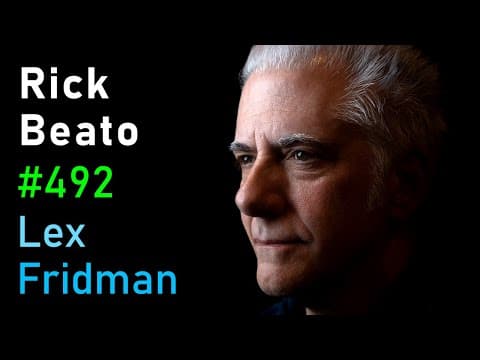
Lex Fridman & Rick Beato on perfect pitch ear training development
Key Takeaways
- •Rick Beato sat down with Lex Fridman on episode #492 of the Lex Fridman Podcast to discuss the science of musical ear development, perfect pitch, and how early childhood exposure to complex music may permanently shape auditory ability.
- •Beato draws on his experience exposing his son Dylan to Bach and sophisticated jazz before and after birth, with Dylan later demonstrating verifiable perfect pitch by age two.
- •The conversation covers how perfect pitch development mirrors language acquisition in infants, why relative pitch is arguably more useful for working musicians, and what practical ear training actually looks like day to day.
Perfect Pitch vs. Relative Pitch and Why the Distinction Actually Matters
People use "perfect pitch" as a catch-all compliment for anyone who seems musical, but Rick Beato draws a hard line between the two concepts. Perfect pitch is the ability to name any note in isolation, no reference point required. Relative pitch is the ability to identify a note once you have been given one to work from. According to Beato on the Lex Fridman Podcast, relative pitch is the more practically useful of the two for the vast majority of musicians. It lets you hear an interval and know what it is, construct a scale from a starting point, and recognize chord progressions by ear in real time. Perfect pitch is remarkable and occasionally useful. Relative pitch is what actually gets you through a session. Beato built his entire ear training course around developing relative pitch through daily identification of melodic and harmonic intervals, stacking those skills until chord recognition and scale understanding follow naturally. The implication is that most people chasing the wrong target are also skipping the one that would actually make them better players.
Babies Might All Start With Perfect Pitch
Here is where things get genuinely strange. Beato's theory, which he connects to existing research on infant language development, is that perfect pitch is not a rare gift distributed randomly at birth. Every infant may have it. The same way babies are born capable of distinguishing phonemes from any human language and then narrow down to only the sounds of their native tongue around nine months, Beato believes infants possess "a universal pitch awareness that fades if it goes uncultivated." The window closes. The ability doesn't disappear entirely but it calcifies into something much harder to access. If this maps onto the language research the way Beato suggests, then perfect pitch isn't talent, it's retention. That reframes the whole conversation about musical genius in a way that is either exciting or deeply annoying depending on how old you were when you gave up piano lessons. Related: Disney animatronic characters technology failure: Living Characters
Dylan Beato and the Experiment That Wasn't Really an Experiment
Rick Beato did not set out to run a controlled study on his son. He just played music constantly, before Dylan was born and throughout his early childhood, specifically choosing what he calls high-information music, Bach, bebop jazz, harmonically dense material that gives a developing auditory system a lot to process. By the time Dylan was two, he was singing along to complex guitar solos in the correct keys. By three and a half, he was identifying specific notes and matching them to songs by name without any reference pitch being given to him first. The confirmation came gradually and somewhat accidentally. Beato eventually recorded it casually, the video went viral, and it became the first widely seen content on his YouTube channel. What is striking about all of this is that Beato's approach was less structured musical education and more sustained immersion, the same mechanism behind language fluency rather than language instruction.
The Language Acquisition Parallel and What It Suggests for Early Music Education
Beato's framework leans heavily on the idea that music is acquired the way language is, through exposure, immersion, and social engagement rather than formal instruction in the early stages. His father was not a musician but played bebop records at home, and Beato absorbed Charlie Parker and Dizzy Gillespie as ambient sound long before he could analyze what made it work. That early saturation shaped how his ear processed complexity later. The same principle applied when Beato played sophisticated jazz and Bach for Dylan. The argument is not that any child who hears enough Coltrane will develop perfect pitch. It's that the auditory system, like the linguistic one, is most plastic in its earliest window, and what you feed it during that window determines the ceiling. This is the kind of idea that sounds intuitive once someone says it out loud, and then you immediately start thinking about every music class that spent six weeks on hot cross buns. Related: Kurtis Conner Tackles Performative Masculinity Social Media
What Bebop Actually Did for Beato's Ear
Bebop is not easy listening. It is harmonically and rhythmically demanding music that was not designed to be background noise, which is exactly why Beato credits it with developing his ear in ways that more conventional exposure probably wouldn't have. His father appreciated the sophistication of artists like Charlie Parker and Dizzy Gillespie without being a practicing musician himself, and that enthusiasm filtered through to Beato early. Bebop's complexity meant his ear was constantly being pushed to track fast-moving harmonic information. Beato describes this as a kind of musical stress test that built capacity over time. You could draw a comparison to the way that this full conversation plays out in Rick Beato: Greatest Guitarists of All Time, History & Future of Music | Lex Fridman Podcast #492, where Beato walks through the cumulative effect of that early immersion on everything that came after.
Our Analysis: Beato and Fridman spend a lot of time orbiting the "what makes genius" question without ever landing. The most honest answer slips out quietly: early exposure works like language acquisition. Miss the window, and you're always translating. That's genuinely useful to know.
The Gilmour point is funnier and truer than they let it be. Feeling beats technique in comment sections every single time, and no amount of music theory education will fix that. Maybe it shouldn't.
The AI music take is the weakest part. "No soul" is a lazy place to stop. The real question is whether listeners will eventually stop caring.
Frequently Asked Questions
Can adults develop perfect pitch through ear training, or is it only possible in childhood?
What's the difference between perfect pitch and relative pitch, and which actually matters for musicians?
How does early music exposure affect perfect pitch ear training development in young children?
Is perfect pitch genetic, or is it something that can be learned through environment?
Does listening to bebop jazz actually help develop a child's musical ear?
Based on viewer questions and search trends. These answers reflect our editorial analysis. We may be wrong.
Source: Based on a video by Lex Fridman — Watch original video
This article was created by NoTime2Watch's editorial team using AI-assisted research. All content includes substantial original analysis and is reviewed for accuracy before publication.