Eddy Burback's Digital Detox Smartphone Experiment
Key Takeaways
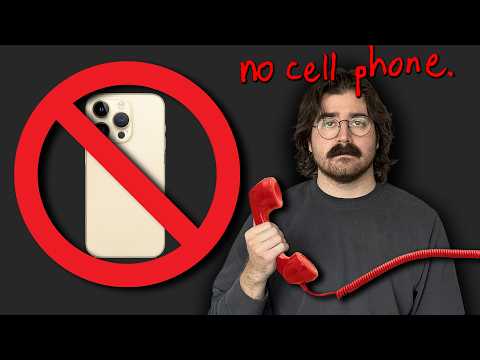
- •YouTube creator Eddy Burback locked away his smartphone for a full month to see what life actually looks like without one, documenting the entire digital detox smartphone experiment on his channel in a video titled 'I hate my phone so I got rid of it.' Driven by a creeping sense that social media algorithms were treating him like a lab rat — feeding him content he didn't want and couldn't stop consuming — he replaced his phone with a landline, a Rolodex, a film camera, and a physical calendar.
- •What followed was a month of phantom limb syndrome, spam calls, better books, and fewer anxiety spirals.
- •He's not going full Luddite, but he's not going back to how things were either.
What Happens When You Quit Your Smartphone for a Month
Eddy Burback's digital detox smartphone experiment starts where most people's frustration quietly lives: the moment you pick up your phone to do one thing and resurface twenty minutes later having watched none of the things you wanted to watch.
That slow-burn irritation eventually pushed him to lock the device away entirely for four weeks — not as a stunt, but as a genuine reset for someone in their late twenties navigating a big city solo. He documents the whole thing in I hate my phone so I got rid of it, on his YouTube channel.
The First Week: Phantom Limb Syndrome and Digital Withdrawal
The first few days, he kept reaching for a phone that wasn't there. Classic phantom limb — his body had developed its own muscle memory around the device.
What replaced the scrolling was something he describes as genuine boredom, a state he hadn't experienced in years. Surprisingly, it didn't feel like deprivation. It felt like space. He also noticed that sitting through a movie without a buzzing rectangle in his pocket was a fundamentally different, better experience — which says something about how low the bar had gotten.
How Retro Technology Can Replace Your Smartphone — Mostly
Rather than grabbing a basic flip phone, Burback went further back. He set up a landline and built out a Rolodex for contacts, aiming to simulate a pre-cell phone era of connectivity rather than just a downgraded version of the present one.
He filled in the rest of the gap with a physical calendar, notebooks, a traditional alarm clock, and a film camera. For the few tasks that genuinely required a screen, he used an old laptop with a chess clock to cap his time on it — a workaround that acknowledges you can't fully opt out of digital life in 2024, but you can at least make it annoying enough to stay intentional.
Using a Landline and Rolodex in the Modern World
The landline, weirdly, became a highlight. Calls felt more deliberate — people left actual voicemails, made actual plans, and the whole interaction had a weight that a text thread doesn't.
Friends apparently enjoyed it. Making plans felt less like managing a group chat and more like, as Burback puts it, something worth doing. The Rolodex, meanwhile, is exactly as charming and impractical as it sounds, and that's fine.
The Surprising Benefits of a Smartphone Detox
The practical inconveniences of navigating without a phone — figuring out that an AMC movie ticket could be redeemed with a credit card, learning that bus routes get announced out loud — turned out to be minor. The mental shift was the bigger story.
Improved Attention Span and Reading Focus
Burback found himself reading books for long stretches, something that had become almost impossible when his phone was nearby. Work improved too — less procrastination, more actual output.
It's the kind of result that sounds obvious in theory but lands differently when someone documents it happening in real time over thirty days. His attention span, essentially, had been quietly eroded and then quietly rebuilt.
Reduced Anxiety and Better Mental Health
Without a constant feed of social media, the low-grade anxiety that comes with it — the negativity, the outrage, the sense that everything is always happening somewhere you're not — largely disappeared.
He also started noticing small things again. Watching rain. Talking to strangers for directions. The kind of micro-interactions that smartphones have been slowly replacing for fifteen years. If you're curious about how creators are examining the way technology shapes perception, I hate my phone so I got rid of it is worth your time.
Our Analysis: Burback gets the diagnosis right but softens the prescription — a month of inconvenience followed by "I'll just use my phone less" is the digital detox genre eating its own tail.
This fits a growing wave of tech-skeptic content where the real product being sold is nostalgia, not solutions — film cameras and Rolodexes are aesthetics, not answers.
The more interesting video nobody's made yet: what happens when someone actually stays off it for a year, career intact, relationships intact — that's the one that would genuinely scare Silicon Valley.
Frequently Asked Questions
What actually happens to your attention span during a digital detox smartphone experiment?
Is quitting your smartphone for a month actually sustainable for someone living alone in a city?
How long does the phantom limb sensation from phone addiction actually last?
Does quitting social media actually reduce anxiety, or does it just feel that way?
What are the best retro technology alternatives to a smartphone if you want to do a life without a smartphone for a month?
Based on viewer questions and search trends. These answers reflect our editorial analysis. We may be wrong.
Source: Based on a video by Eddy Burback — Watch original video
This article was created by NoTime2Watch's editorial team using AI-assisted research. All content includes substantial original analysis and is reviewed for accuracy before publication.