Understanding How Stormwater Retention Ponds Work
Key Takeaways
- •Retention ponds aren't just decorative lakes — they're engineered flood control infrastructure hiding in plain sight.
- •Practical Engineering's video 'Do Retention Ponds Actually Work?' breaks down how stormwater ponds manage urban runoff and why civil engineers treat outlet structures like precision instruments.
- •The short answer is yes, they work.
What Are Stormwater Retention Ponds?
If you've ever wondered how stormwater retention ponds work, Atlanta's Historic Fourth Ward Park is a good place to start — it's a public green space built around a large pond that was specifically engineered to stop a neighborhood from flooding.
That's the thing about retention ponds: most people assume they're landscaping. They're not. They're infrastructure with a water feature bolted on top.
Detention and retention ponds are two related but distinct tools. Detention ponds drain completely between storms. Retention ponds maintain a permanent pool of water. Both store excess runoff during a rain event and release it slowly — the difference matters most for water quality reasons, which we'll get to.
How Urban Development Increases Runoff
Natural ground absorbs rainfall. It soaks into soil, recharges groundwater, and moves slowly toward streams. Rooftops, parking lots, and roads don't do any of that — water hits and runs.
Practical Engineering points out that urbanization can increase stormwater runoff dramatically compared to the same land in its natural state. The drainage systems built before heavy development often weren't designed to handle that volume, which is why flooding gets worse as cities grow, not better.
How Detention and Retention Ponds Regulate Water Flow
The core job of a stormwater pond is peak flow attenuation — flattening the spike of water that rushes downstream right after a heavy storm.
Think of it like a busy highway on-ramp. Traffic doesn't disappear, it just gets metered. The total amount of water still has to go somewhere, but the pond delays it long enough that the downstream channel isn't hit with everything at once.
Outlet Structure Design and Peak Flow Control
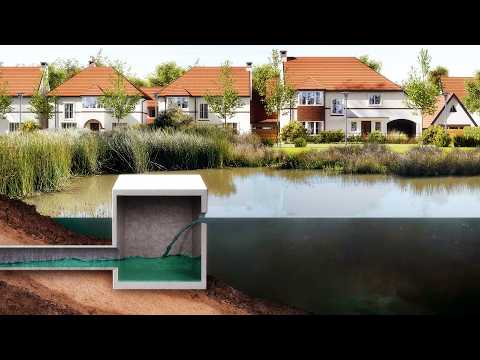
The outlet structure is where the real engineering lives. It's typically a concrete or metal assembly with multiple openings at different heights, each sized to handle a different storm intensity.
A small orifice near the bottom handles light rain — enough to drain the pond slowly over 24–72 hours. Larger openings higher up activate during heavier storms. The biggest events trigger an emergency spillway that bypasses the whole system before the pond overflows its banks. Civil engineers tune these like instruments, calibrating each opening to hit specific flow targets for storms of different return periods — a 10-year storm, a 100-year storm, and everything in between.
Water Quality Benefits of Retention Ponds
Stormwater picks up everything it touches on the way to a pond: motor oil, fertilizer, heavy metals, bacteria, sediment. The pond's job isn't just to hold water — it's also to clean it, at least partially.
Sediment Settlement and Contaminant Removal
Slow-moving water drops what it's carrying. Given enough time in a retention pond, suspended solids settle to the bottom, taking a significant portion of attached contaminants with them.
Retention ponds — the kind with a permanent water pool — are better at this than dry detention basins because the standing water acts as a treatment buffer between storms. Detention ponds drain fully, which means the next storm hits bare sediment and kicks everything back up. It's a meaningful design trade-off, and the right choice depends on what the watershed actually needs.
Regulatory Requirements for Stormwater Management
Most jurisdictions now require new developments to prove they won't make downstream flooding worse. The standard benchmark is pre-development peak runoff — whatever flow rate left the site before construction started, that's the maximum allowed afterward.
That's a tougher target than it sounds. A site that's gone from forest to parking lot might be generating five to ten times more runoff. A stormwater pond is one of the more straightforward ways to meet the requirement — dig a hole, design the outlet, done. As we explored in Do Retention Ponds Actually Work? by Practical Engineering, the engineering behind these systems is far more deliberate than the average passerby would ever guess.
Our Analysis: Practical Engineering nails the outlet structure explanation — that's the part most videos gloss over, and it's actually the whole ballgame for why these ponds don't just flood your neighborhood.
This fits squarely into the 'infrastructure is secretly interesting' DIY wave, where people are finally curious about the systems they walk past every day.
The smart detention angle is where this is all heading — regional systems with real-time controls will quietly make most individual backyard retention solutions obsolete before homeowners even know they exist.
Frequently Asked Questions
What is the difference between a stormwater pond and a retention pond?
How do stormwater retention ponds work to actually prevent flooding?
What are the biggest problems with retention ponds that the video doesn't address?
Does a retention pond actually improve water quality, or just slow water down?
Are retention ponds still the best solution for urban runoff, or are there better alternatives now?
Based on viewer questions and search trends. These answers reflect our editorial analysis. We may be wrong.
Source: Based on a video by Practical Engineering — Watch original video
This article was created by NoTime2Watch's editorial team using AI-assisted research. All content includes substantial original analysis and is reviewed for accuracy before publication.