Winix Wins Best Air Purifier Comparison Test Results
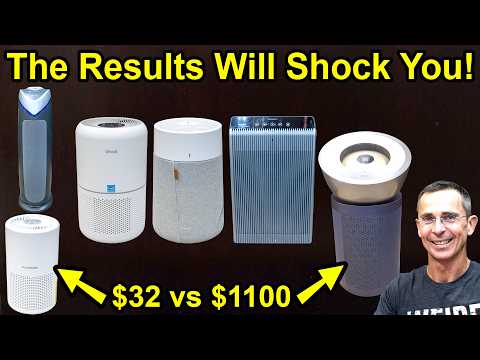
Key Takeaways
- •The Winix air purifier beat every other model tested in Project Farm's exhaustive head-to-head video, "We Tested Every Air Purifier!
- •One Clear Winner!" The channel ran purifiers ranging from $30 to $1,200 through smoke chambers, dust tests, and a real burnt-toast scenario in a 240 sq ft room to find the best air purifier comparison test results across price points.
- •Winix topped the final scorecard on particle removal, the Dyson came in a quiet second, and budget shoppers got two clear picks in the Levoit 300 and Levoit Mini.
Air Purifier Performance Testing Methodology
Project Farm's best air purifier comparison test results came from four distinct challenges, not just one tidy lab number: CFM airflow measurement, a sealed smoke-chamber test, a dust-clearance run, and finally a burnt-toast burn in a real 240 sq ft room with over 4 million mixed particles on the clock. You can see the full methodology in We Tested Every Air Purifier! One Clear Winner! on the Project Farm channel.
The price spread alone — $30 to $1,200 — tells you this wasn't a gentle round-up. Every unit was measured for power draw and noise at the same time, so you get operating cost and livability data alongside raw cleaning numbers.
Airflow (CFM) and Smoke Removal Results
Higher CFM moved visible smoke out faster, but it didn't guarantee the lowest microscopic particle count — a distinction that matters if you're dealing with fine particulates rather than a kitchen disaster.
The Coway posted the highest CFM of any unit tested. The Winix didn't top the airflow chart, but it cleared the smoke chamber fastest and finished with the lowest residual particle count, which is the number that actually affects your lungs.
Dust Particle Removal Efficiency Across Models
Carpet dust was loaded into the test chamber until the counter hit over 200,000 particles, then the purifiers went to work. Almost every unit — including compact models — drove particle counts down to near-zero quickly.
The practical takeaway: if dust is your only concern, you don't need to spend much. Most purifiers with a decent HEPA filter handle dust well enough that the price difference is hard to justify on that metric alone.
Winix Air Purifier: Top Overall Performer
Winix won the overall scorecard by doing well across every test rather than dominating one and falling apart in another. In the burnt-toast room test it cut particle counts by 3.9 million over 30 minutes — the largest reduction of any unit.
Why Winix Won Despite Noise Concerns
It's loud on its highest setting. That's the trade-off. But the same high setting is what drives its cleaning performance, so if you're running it in a bedroom while you sleep, you'll want to test your tolerance for fan noise before committing.
For context on how engineering trade-offs play out in real-world performance testing — the kind where one spec looks great on paper but costs you somewhere else — it's a pattern that shows up everywhere, from air purifiers to power tools to budget laptops.
Our Analysis: Project Farm got the core right — Winix wins, Dyson is a luxury tax on silence, and the Levoit lineup punches well above its price. The one miss: CFM as a proxy for performance is a trap, and they almost fell into it before the particle data saved them.
This fits squarely into the "good enough" DIY trend — people are done overspending on brand names when $80 cleans air as well as $800.
Watch for HEPA filter costs to become the next battlefield; cheap purifiers with expensive proprietary filters will quietly eat your savings.
There's a broader point worth sitting with here: tests like this expose how badly the air purifier market has leaned on CADR ratings and brand storytelling instead of transparent, comparable data. A single controlled room test with real particle counters does more for a consumer than a decade of spec-sheet marketing. The fact that a $30 unit can hang with a $300 one on dust — the most common household complaint — should be deeply uncomfortable for premium brands whose value proposition rests almost entirely on polish and packaging.
The noise trade-off also deserves more attention than it typically gets. Most reviewers treat loudness as a footnote, but for the large portion of buyers who plan to run a purifier overnight, it's arguably the deciding factor. A purifier that cleans brilliantly but keeps you awake is a very expensive white-noise machine. That Winix forces you to make that call consciously is actually useful information — more useful than most spec sheets bother to provide.
Finally, the burnt-toast real-room test format is underrated as a methodology. Sealed chamber numbers are clean and repeatable, but they don't reflect the way airflow, furniture, and room geometry create dead zones in actual living spaces. The gap between chamber performance and real-room performance will likely be the next front in serious air purifier testing — and when it arrives, the rankings may shuffle again.
Frequently Asked Questions
What are the best air purifier comparison test results across different price points?
Is high CFM actually the most important spec when comparing air purifiers?
How does the Winix air purifier compare to Dyson in a real-room test?
Is the Levoit Mini worth buying if you only need dust removal?
Does the Winix air purifier's noise level make it impractical for a bedroom?
Based on viewer questions and search trends. These answers reflect our editorial analysis. We may be wrong.
Source: Based on a video by Project Farm — Watch original video
This article was created by NoTime2Watch's editorial team using AI-assisted research. All content includes substantial original analysis and is reviewed for accuracy before publication.