Adam Savage Masters Radius Cutter Lathe Machining
Key Takeaways
- •The radius of any cut made with a Holdridge-style radius cutter is determined entirely by the distance from the cutting tip to the tool's central pivot — getting that single measurement wrong means the hemisphere will be wrong, full stop.
- •Adam Savage used stacked gauge blocks and a specific mathematical calculation to set the cutter tip at exactly 75mm (2.955 inches) from center for the 150mm ball head receiver, achieving a press-fit result in delrin.
- •A hemisphere cut in richlite validated the entire setup approach before any critical material was touched — test cuts in sacrificial stock are not optional busywork when the tolerances are this tight.
The Tool That Beat Him for Years
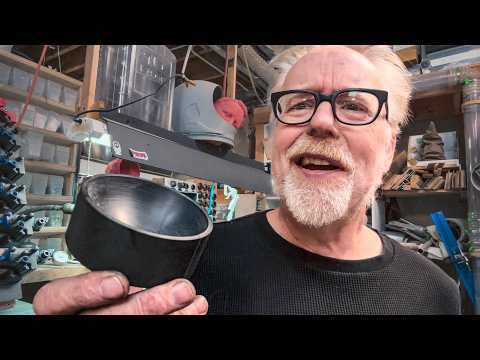
The Holdridge Radii Cutter is not a common shop tool. It's a specialized lathe attachment designed to sweep a cutting tip in a precise arc, carving spherical or hemispherical profiles that no standard toolpath can replicate cleanly. Savage acquired his from Jamie Hyneman's old special effects shop, which tells you something about how niche this equipment is — it lives in places where people build things that need to look exactly right. The problem, as Savage explains in Adam Savage Attemps to Cut a Perfect Hemisphere! on Adam Savage's Tested, is that he'd been using it for years without fully understanding its setup. Not because the tool is obscure voodoo, but because one foundational relationship between the tool and the workpiece hadn't clicked for him yet.
The Number That Actually Matters
Here's the mechanic that governs everything with radius cutter lathe machining: the distance from the cutting tip to the tool's central pivot point is the radius of the cut. That's it. That's the whole thing. Set that distance to 1.75 inches and you get a hemisphere with a 3.5-inch diameter. Get it wrong by a few thousandths and your sphere won't seat, won't seal, and won't work. Savage had been close before, but close isn't the same as repeatable. The insight that finally landed for him was understanding that the workpiece diameter and the cutter's radius setting have to be matched with intention, not approximation — which sounds obvious written out, and apparently felt very obvious to him too, once it finally clicked after years of frustrating near-misses.
Gauge Blocks and the Art of Stacking Precision
To actually hit the target dimension, Savage didn't eyeball it or use a single reference point. He used gauge blocks — precision ground steel blocks that can be "rung" together, meaning stacked with a specific technique that causes them to adhere with almost no air gap, giving you a combined length accurate to fractions of a thousandth of an inch. For the 3.5-inch hemisphere project, he designed custom gauge blocks to set the exact cutter tip position. For the 150mm ball head receiver, he calculated the required radius as 75mm, converted that to 2.955 inches, and built the gauge block stack to match. The math is straightforward. The execution is where most people drift. Precision work at this level has more in common with careful ritual than with raw skill, and Savage treats it accordingly.
The Test Cut That Proved the Theory
Before any camera hardware entered the picture, Savage ran his first properly calibrated cut on a richlite block. Richlite is a dense, machined-paper composite — stable enough to hold detail, forgiving enough to use as a test bed without burning through expensive stock. He made sweeping passes with the radius cutter, let the tool do what it was designed to do, and then pressed a 3.5-inch test hemisphere into the void. It fit. Not approximately. Not with shimming. It fit the way a precisely machined part is supposed to fit, which is to say it seated with that particular satisfying resistance that tells you the geometry is right. There was a minor cosmetic mark from some epoxy, but the functional result was exactly what years of radius cutter lathe machining attempts had failed to produce before this setup. The kind of relief in his voice at that moment is hard to fake.
Putting It to Work on Something Real
The 150mm ball head receiver is a practical piece of camera infrastructure — a receiver that allows a large ball head to seat into a custom rail platform for film work. It's the kind of component that gets machined when off-the-shelf hardware either doesn't exist or doesn't fit the specific geometry of a custom rig. Savage machined a large piece of delrin for this, first cutting a flat back surface, then using the radius cutter to carve the spherical receiver. The same principles applied: gauge blocks for the cutter offset, careful alignment, deliberate passes. The finished assembly bolted together with stainless steel hardware and gave the camera platform a stable, adjustable base. For anyone curious about precision fabrication applied to real-world DIY rigs, this sits in the same spirit as projects like robotic golf putter auto-aiming technology, where the machined components have to be right because the function depends entirely on the geometry.
Why Setup Beats Skill Every Time
The broader lesson from watching Savage work through this is uncomfortable if you've spent a lot of time developing feel-based workshop instincts. The radius cutter doesn't reward experience unless that experience is paired with correct setup. You can be a seasoned machinist and still get a bad hemisphere if the gauge block stack is off or the pivot alignment is wrong. Savage is explicit about this: the tool gave him bad results for years not because he lacked skill, but because the calibration wasn't right. That kind of honest accounting is useful for anyone who's ever blamed their tools when the real culprit was the setup procedure. Precision machining, whether you're cutting hemispheres or working on something as ambitious as a DIY go-kart build from scratch, punishes skipped steps with consistent, maddening predictability. Get the setup right and the tool does the work. Skip it and you're just generating expensive scrap with confidence.
Our Analysis: Adam nails the tactile side of this but breezes past the part that will trip up most DIYers: the radius cutter setup is deceptively sensitive, and he undersells how badly a misaligned cutting tip ruins your workpiece before you even know something is wrong.
The jump to a 150mm ball head receiver feels like a separate video stapled on. Useful, but it muddies the teaching moment around the hemisphere cut right when that lesson was finally clicking.
If you own a lathe and need to fit any spherical object precisely, the diameter-to-radius alignment point alone is worth your time here.
Frequently Asked Questions
How do you make a radius on a lathe?
What is the minimum radius for machining?
How does radius cutter setup and calibration affect the final cut?
What are gauge blocks used for in lathe machining?
Can you machine a hemispherical void in delrin on a standard lathe?
Based on viewer questions and search trends. These answers reflect our editorial analysis. We may be wrong.
Source: Based on a video by Adam Savage's Tested — Watch original video
This article was created by NoTime2Watch's editorial team using AI-assisted research. All content includes substantial original analysis and is reviewed for accuracy before publication.