Marshall Iwaasa Disappearance Case: What Happened?
Key Takeaways
- •Marshall Iwaasa, a college student from Alberta, vanished in 2019 after a trip to a storage unit in Lethbridge, and six days later his truck was found completely burned on a remote logging trail near Pemberton, British Columbia — 14 hours from his last known location.
- •Despite a removed steering column, smashed electronics, two passports, and clothing that appeared to belong to someone else, RCMP initially declared nothing suspicious had occurred.
- •Barely Sociable's video 'The Pemberton Incident - An Unsolved Mystery' traces how that early dismissal cascaded into a botched investigation, connecting Marshall's case to the disappearance of Daniel Riou through a red cooler, a name written in marker, and a bar witness who claims he watched two men fear for their lives.
Who Was Marshall Iwaasa
Marshall Iwaasa was a college student living in Alberta who, by all family accounts, was quietly working on a video game in his spare time. In November 2019, he made the drive down to Lethbridge to see his mother and pick up something from a storage unit — a computer part, his family believed, for the game he was building. He never came back. Keypad records from the storage facility later revealed something stranger than a routine errand: Marshall had spent the better part of a night repeatedly failing to enter the unit before finally getting inside at 6 AM, where he remained for roughly two and a half hours. A packed bag found later at the scene — clothes, toiletries — suggested whatever he was doing, it wasn't a simple grab-and-go.
A Truck on Fire, in the Middle of Nowhere
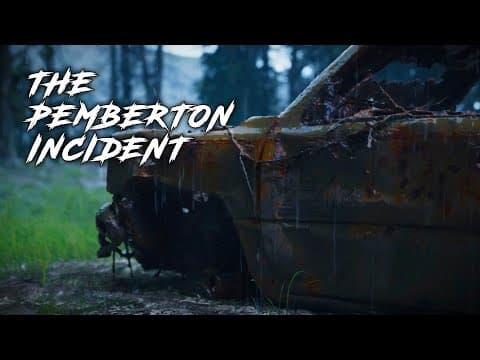
Six days after Marshall was last seen, hikers stumbled onto a completely torched truck on a remote logging trail near Pemberton, British Columbia. That location is approximately 14 hours from his last known position in Alberta, which is the kind of detail that should stop any reasonable person cold. Scattered around the wreckage were smashed electronics, clothing, and two passports. The steering column had been removed. According to The Pemberton Incident - An Unsolved Mystery by Barely Sociable, the hikers who found the scene immediately described it as feeling like a crime scene. That observation is doing a lot of heavy lifting given what came next.
The Police Called It Non-Suspicious
RCMP responded to the burned truck and, following their assessment, declared nothing suspicious had occurred. No forensic testing was ordered. The vehicle was left largely unsecured, meaning whatever evidence hadn't already burned was now exposed to weather and anyone who might walk past. The family pushed for answers and got bureaucratic language in return: no action without credible, corroborated, and compelling evidence. The problem with that standard, as the video makes clear, is that the credible and compelling evidence was sitting right there on a logging trail and nobody was treating it like it mattered. Investigators also reportedly failed to pull nearby gas station surveillance footage in time, a window that closed while the family was still waiting for the case to be taken seriously. Cases where early inaction compounds into permanent information loss are unfortunately not rare — the
Our Analysis: Barely Sociable does the connective work the RCMP plainly refused to. The cooler, the relative's retracted comment, the eyewitness who knew details he shouldn't have known unless they were real. Each thread holds. That's not speculation. That's pattern recognition the investigating agency actively resisted doing.
What the video skips over is how much the storage unit scene matters. Two hours of failed attempts, then a long stay inside. Whatever Marshall was doing in that unit likely explains everything that follows. Nobody asked publicly what was in it.
The RCMP's own logic collapses the moment a private investigator finds a lighter at a scene they called inconclusive.
There's also a broader institutional failure worth naming here. The threshold language the RCMP used — credible, corroborated, compelling — isn't inherently unreasonable. But applied to a burned vehicle on a logging road 14 hours from where the missing person was last seen, with a removed steering column and two passports in the debris, that language becomes a bureaucratic shield rather than an investigative standard. The framework exists to filter noise. In Marshall's case, it filtered out signal instead.
What cases like this expose is the gap between how disappearances are categorized and how they're actually worked. An adult who leaves voluntarily requires different resources than a homicide. The problem is that the initial classification — suspicious or not, voluntary or not — tends to stick. Once RCMP logged the truck scene as non-suspicious, every subsequent decision was downstream of that call. Reversing it required the family to generate enough pressure to force a reclassification, which is an extraordinary burden to place on grieving people who are already doing the investigative work themselves.
The connection to Daniel Riou, if it holds, would mean two separate disappearances fed into the same investigative void and neither got the scrutiny the physical evidence demanded. That's not a coincidence problem. That's a systems problem. And it's one that content like Barely Sociable's video is increasingly well-positioned to surface, even when official channels won't.
Frequently Asked Questions
Did they ever find Marshall Iwaasa?
When did Marshall Iwaasa go missing?
What evidence connects Marshall Iwaasa and Daniel Riou in the Pemberton incident?
Why did RCMP initially say Marshall Iwaasa's burned truck was not suspicious?
What did police do wrong in the Marshall Iwaasa disappearance case?
Based on viewer questions and search trends. These answers reflect our editorial analysis. We may be wrong.
Source: Based on a video by Barely Sociable — Watch original video
This article was created by NoTime2Watch's editorial team using AI-assisted research. All content includes substantial original analysis and is reviewed for accuracy before publication.