Apple Vision Pro review $3500: A Month with Apple's Headset
Key Takeaways
- •Apple's Vision Pro headset launched at $3,500, and Eddy Burback spent a month with it to find out whether it justifies that price.
- •In his video 'Apple's $3500 Nightmare,' Burback documents a purchasing process that quietly pushes the total cost toward $4,000 for glasses wearers, an app ecosystem that barely qualifies as one, and a psychological side effect nobody in the marketing materials mentioned: removing the headset and still expecting floating screens to be there.
- •The honest answer to whether it's worth it is no, but the reasons why are more interesting than a simple thumbs down.
What $3,500 Actually Gets You
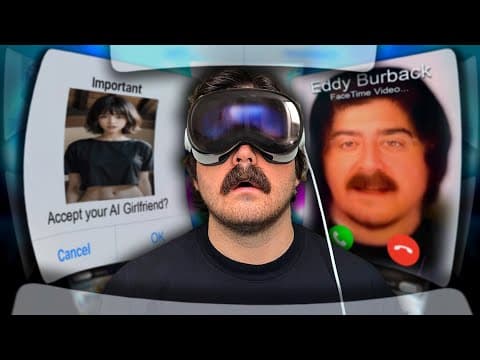
The Apple Vision Pro is marketed as a spatial computing device, which is Apple's way of saying it layers digital content over your view of the real world using external cameras. You see your surroundings, but with windows, screens, and apps floating in front of them. Eddy Burback's video Apple's $3500 Nightmare walks through the pitch carefully before methodically dismantling it. The device works. The technology is real. The question Burback keeps returning to is whether any of it solves a problem that anyone actually has, and a month of daily use didn't produce a convincing answer.
The Price Tag Has Fine Print
The $3,500 number gets the headline, but the checkout process has layers. Buying the Vision Pro requires a detailed face scan during purchase, similar to Face ID setup, so Apple has your facial geometry before the box is even opened. For anyone who wears glasses, the device does not accommodate standard frames, which means mandatory optical inserts at $149 on top of the base price. Burback's total landed around $4,000. The Apple Store pickup involved a large branded bag that he describes as making him feel "conspicuous in a way that was more embarrassing than exciting." It is genuinely impressive hardware, and Apple made sure you feel every dollar of that on the way out the door.
An App Store That Forgot to Show Up
Two days in, Burback ran out of things to do. The Vision Pro's app library at launch was thin in a way that felt less like a new platform finding its footing and more like a proof of concept that shipped before the content did. Gaming options leaned on existing iPad apps with no spatial redesign, and online multiplayer was effectively impossible because the user base was too small to populate a lobby. The environments were technically impressive but limited to passive exploration. Being virtually on the moon is a neat trick once. The dissatisfaction Burback documents here is less about the technology failing and more about there being nowhere interesting to take it, which for a $4,000 device is a damning gap.
Our Analysis: Burback accidentally made a better case for the Vision Pro than most tech reviewers did, precisely because he hated parts of it. The boredom he felt is real data. A $3,500 device that makes you feel like you're waiting for the internet to be invented is not a consumer product. It's a bet.
The part nobody wants to say plainly is that Apple does not need this to be good yet. They need people to buy it, build for it, and normalize wearing a computer on your face. You are the beta test.
That should bother you more than the price tag.
What makes this particular moment in the Vision Pro's lifecycle genuinely strange is that Apple built the hardware argument almost perfectly. The display quality, the hand and eye tracking, the seamless passthrough — none of that is the problem. The problem is that Apple shipped a solution and forgot to confirm what the problem was. Spatial computing sounds inevitable until you sit with it for a month and realize the most compelling use case is watching a movie alone on a very expensive screen.
There's also a class dimension that reviewers keep dancing around. The people most likely to spend $4,000 on a first-generation headset are the same people least likely to feel the friction of its limitations. They have home offices. They have time to experiment. They are not the average person trying to figure out whether this replaces anything in their actual life. The Vision Pro's early adopter base is, almost by design, the worst possible sample for predicting whether this technology has mainstream legs.
The psychological effect Burback documents — reaching for a floating screen that isn't there after taking the headset off — is probably the most honest signal in the whole video. That's not a bug. That's the product working exactly as intended, conditioning you to want more of it. The question is whether Apple can build a world worth returning to before the novelty wears off entirely. Right now, the answer is not yet, and for most people, not yet at $3,500 means not ever.
Frequently Asked Questions
Is the Apple Vision Pro worth $3500, or does the real cost go even higher?
What can you actually do with the Apple Vision Pro day-to-day?
How does the Vision Pro app store compare to Meta Quest at launch?
Does the Apple Vision Pro cause any unexpected psychological effects after extended use?
Why does Apple require a face scan to buy the Vision Pro?
Based on viewer questions and search trends. These answers reflect our editorial analysis. We may be wrong.
Source: Based on a video by Eddy Burback — Watch original video
This article was created by NoTime2Watch's editorial team using AI-assisted research. All content includes substantial original analysis and is reviewed for accuracy before publication.