LED Christmas Lights vs Incandescent Color Quality: 2025 Breakdown
Key Takeaways
- •Technology Connections is back with its annual Christmas light breakdown, and the 2025 edition makes a pointed case that modern LED Christmas lights are actively making holiday displays worse.
- •The problem isn't the LED technology itself — it's that most manufacturers skip color filters entirely and use individual colored diodes that blast pure, oversaturated hues directly at your eyeballs.
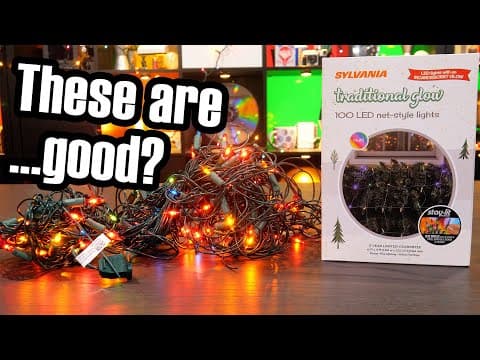
- •The good news: smaller companies like Tru-Tone and Vintaglow have been building filtered LED lights that actually replicate the warm, nuanced look of old incandescent sets, and now mainstream brands including Sylvania and Home Depot are starting to follow their lead.
Why Old Christmas Lights Looked Like That
Incandescent Christmas lights were never really colored bulbs in the way most people think. They were white light sources wrapped in colored filters, and that distinction matters enormously. The filter absorbed certain wavelengths, which meant the resulting color was softer, slightly impure, and visually warmer than any single-frequency light source could produce. Different colors also came through at different brightness levels depending on how much light the filter blocked, which gave a multicolor string a kind of natural visual rhythm. In It's the Christmas light video again - 2025 edition, Technology Connections walks through this mechanism in detail, and once you understand it, you can't unsee why modern strings look so wrong.
What LED Sets Actually Do Instead
Most LED Christmas lights don't bother with filters. Each socket gets its own dedicated colored diode — a red LED for red, a blue LED for blue — and those diodes produce extremely pure, narrow-spectrum light. Pure in this context is not a compliment. The result is colors that read as aggressive and electronic rather than festive. Blue and green diodes tend to be naturally brighter than red and warm-toned ones, so multicolor sets often end up visually dominated by the cooler hues, which compounds the problem. The overall effect, as Technology Connections describes it, is less holiday warmth and more industrial indicator light. Anyone who has stood in front of a modern LED display and felt vaguely unsettled by it without being able to explain why now has their answer.
The Companies That Actually Solved This
While the major manufacturers were racing to make LEDs cheaper and brighter, a couple of smaller operations were asking a different question: what if you just put a filter on a warm white LED? Tru-Tone and Vintaglow both landed on this approach, using warm white diodes behind colored filters to replicate the exact optical mechanism that made incandescent strings look good. The colors come out softer, the brightness variation between hues feels natural, and the overall string reads as festive rather than intense. Technology Connections has covered this concept before using DIY methods, so seeing dedicated products on the market is the validation of an idea that was apparently too obvious for the big players to notice for years. If you enjoy tracking down well-engineered niche products the way you might track down a It's the Christmas light video again - 2025 edition
Our Analysis: Alec gets the Christmas lights argument right, but he's really making a broader point he never quite lands: the lighting industry optimized for specs at the direct expense of experience. Lumens went up, satisfaction went down.
What he skips is the demand side. Consumers kept buying the garish stuff. Bad LED lights didn't survive despite people's preferences, they survived because most buyers never connected the harsh glow to the product until someone like Alec explained it. That's a meaningful distinction — it's not that people liked the cold, aggressive look, it's that they lacked the vocabulary to reject it. The average shopper reads a box, sees "bright," "energy efficient," and "long lasting," and buys. Nothing on that box tells you the blue diode is going to visually overwhelm the red one and make your porch look like a server room.
This is actually a recurring failure mode in consumer hardware: the specs that are easy to measure and print on packaging end up winning over qualities that matter more but resist quantification. Lumens is a number. "Warmth" is not. Manufacturers optimized for the number because that's what they could sell. The incandescent-era filter approach produced something harder to communicate — a quality of light rather than a quantity of it — and so it got quietly dropped when LEDs arrived.
The Sylvania "traditional glow" trend is real and worth watching. If it holds, it's one of the rare cases where a YouTube creator measurably nudged a product category. But it's also worth noting that Tru-Tone and Vintaglow got there first, years earlier, without the algorithmic tailwind. That's either a story about the limits of niche marketing or a story about how long it takes a self-evidently correct idea to reach critical mass. Probably both. The bigger question now is whether mainstream adoption will hold once the novelty fades, or whether the race back to cheap and bright will resume the moment consumers stop paying attention.
Frequently Asked Questions
Does Christmas look better with incandescent or LED lights?
What are the cons of LED Christmas lights when it comes to color quality?
Why don't they make incandescent Christmas lights anymore?
Can you actually get LED Christmas lights that look like old-fashioned incandescent ones?
Based on viewer questions and search trends. These answers reflect our editorial analysis. We may be wrong.
Source: Based on a video by Technology Connections — Watch original video
This article was created by NoTime2Watch's editorial team using AI-assisted research. All content includes substantial original analysis and is reviewed for accuracy before publication.