Best Corded Vacuum Comparison 2025: Project Farm Test
Key Takeaways
- •Project Farm's video 'I've Never Tested A Vacuum This Good!' puts eight corded vacuums through a brutal gauntlet of real-world tests, ranging from a $60 Dirt Devil to a $600 Dyson, to find out whether price actually buys performance.
- •The Dyson and Shark Power Detect tied at the top across carpet cleaning, hard floor pickup, suction power, and air filtration, while the budget Eureka Power Speed quietly outperformed vacuums costing three times as much in several categories.
- •The most alarming finding: many budget vacuums don't just fail to clean the air — they actively make it worse by pumping fine dust particles back into the room.
$60 vs. $600, Measured Honestly
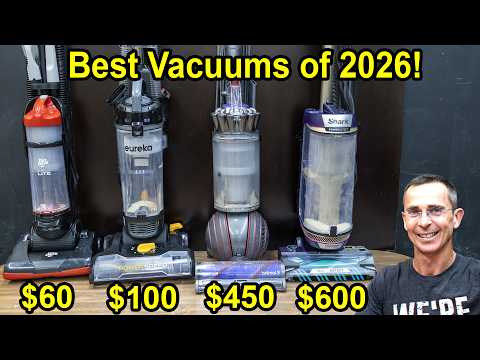
Project Farm lined up eight corded vacuums and ran them through the same tests, same surfaces, same dust loads, no brand getting a softer landing than another. The lineup included the Dirt Devil, Eureka Air Speed, Eureka Power Speed, Bissell, Shark Navigator, Hoover, Shark Power Detect, and Dyson. Prices spanned from around $60 to $600. The point wasn't to confirm that expensive vacuums are better. It was to find out by exactly how much, and whether that gap is worth the money depending on what you're actually cleaning. Most vacuum reviews don't answer that. This one tried to.
Where the Dyson and Shark Power Detect Pulled Away
In sealed airflow testing, the Dyson topped out at 57 CFM. The Shark Power Detect followed closely. When suction was measured in water column inches, the Shark Power Detect hit 101 inches, with the Dyson and Hoover also performing well in that metric. On carpet, the Dyson pulled 95 grams of sand, the Shark Power Detect collected 92 grams. In the airsoft ball test simulating larger debris, the Shark Power Detect collected every single ball for a perfect score, with the Eureka Power Speed and Dyson also performing strongly. Both the Dyson and Shark Power Detect also prevented hair from wrapping around the brush roll entirely, which anyone who has spent ten minutes with scissors untangling a vacuum will immediately recognize as a bigger deal than it sounds.
The Budget Vacuum That Keeps Embarrassing Its Competition
The Eureka Power Speed is the kind of product that makes you distrust premium pricing in general. It turned in strong numbers on air movement, sand pickup from carpet, and cleaning directly along walls and edges, categories where you'd expect a budget machine to quietly fail. Both Eureka models showed up in the top performers for edge cleaning alongside the Dyson, which is not a sentence that looks right but is accurate according to the test results. For households without pets and without serious air quality concerns, the Eureka Power Speed makes a genuinely hard case for itself. The fact that a sub-$100 vacuum can trade punches with machines at four times the price in mechanical cleaning tests says something uncomfortable about how much of a vacuum's retail price is actually engineering versus branding.
The Air Quality Test Changed Everything
This is where the budget vacuum story gets complicated. Project Farm measured airborne dust particle counts before and after running each vacuum, and several models — among them the Dirt Devil, both Eureka machines, and the Bissell — wound up raising the concentration of fine particles in the air rather than reducing it. These vacuums clean the floor and seed the air with particles you can't see. For most people without allergies or respiratory conditions, that might be an acceptable tradeoff. For anyone who cares about indoor air quality, it isn't. If you've spent any time researching air purifiers, the data from I've Never Tested A Vacuum This Good! will feel immediately familiar — and immediately uncomfortable.
Our Analysis: Project Farm did the dirty work here, literally, and the CFM and water column data is the rare kind of number-crunching that actually changes a buying decision. Hard to argue with that rigor.
What got glossed over is filtration as a health issue, not a performance one. If you have allergies or kids on the floor, a vacuum that scores well on carpet pickup but dumps fine particles back into the air is actively making things worse. The Hoover smoking out mid-test tells you everything about what corners get cut when price drops.
There's a broader industry problem hiding in these results. Vacuum marketing has always leaned on suction numbers and floor pickup claims — metrics that photograph well and quote cleanly on a box. Air filtration quality, by contrast, is invisible, harder to demonstrate at retail, and easy to deprioritize without anyone noticing until they've been breathing recirculated dust for years. The fact that budget manufacturers can hit competitive mechanical cleaning numbers while skimping on filtration suggests the cost savings aren't coming from motor efficiency or clever engineering — they're coming from cheaper filter media and looser seals around the dustbin. That's not a tradeoff that shows up in a standard review, which is exactly why tests like this one matter. Most households buying a $70 vacuum aren't thinking about HEPA ratings. After seeing what several of these machines put back into the air, maybe they should be.
Frequently Asked Questions
Is the Dyson worth $600 over the Shark Power Detect in the best corded vacuum comparison 2025?
Do budget vacuums actually make indoor air quality worse?
How does the Eureka Power Speed perform compared to vacuums that cost three or four times as much?
What does CFM mean for vacuum suction, and does a higher CFM always mean better cleaning?
Which corded vacuum is best if you have pets and need to avoid hair tangles?
Based on viewer questions and search trends. These answers reflect our editorial analysis. We may be wrong.
Source: Based on a video by Project Farm — Watch original video
This article was created by NoTime2Watch's editorial team using AI-assisted research. All content includes substantial original analysis and is reviewed for accuracy before publication.