Praggnanandhaa vs Sindarov FIDE Candidates 2026: Shock Win!
Key Takeaways
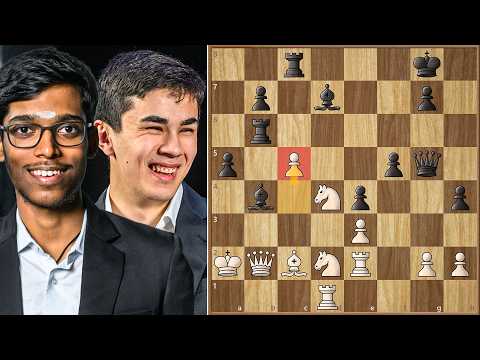
- •Javokhir Sindarov defeated Praggnanandhaa in Round 3 of the FIDE Candidates Tournament 2026, winning on move 40 after a daring piece sacrifice reshaped the entire game.
- •Sindarov, who qualified by winning the FIDE World Cup, stunned Prag with an unexpected deviation from a known Magnus Carlsen game before launching a knight sacrifice on B4 that left White's king permanently exposed.
- •Agadmator breaks down the full game in his video 'GOTD || Praggnanandhaa vs Javokhir Sindarov || FIDE Candidates Tournament 2026 R3', tracing how Prag's time pressure and a critical Queen B3 error sealed the result.
Two Young Guns, One Very Uncomfortable King
Round 3 of the FIDE Candidates Tournament 2026 put two of chess's most dangerous young players across the board from each other. Praggnanandhaa got there by winning the FIDE Circuit 2025. Javokhir Sindarov got there by winning the FIDE World Cup. Neither of them plays scared, and nobody in the building was expecting a quiet draw. In his video GOTD || Praggnanandhaa vs Javokhir Sindarov || FIDE Candidates Tournament 2026 R3, Agadmator makes it clear that whatever restraint either player had, it evaporated fast.
The Harwitz Gamble
Prag opened with D4 and steered the game into a Queen's Gambit Declined, specifically the Harwitz Attack, characterized by an early Bishop to F4 rather than the more common Bishop G5. According to Agadmator, this is a line built for chaos. It trades some of the traditional positional clarity of the QGD for positions where both sides have genuine chances to go wrong or go wild. Prag was clearly looking for a fight, not a handshake on move 30. Choosing a line named after Daniel Harwitz to try to crack a World Cup winner is either bold preparation or a very specific kind of confidence.
The Carlsen Reference That Wasn't
Here is where Sindarov showed exactly why he belongs in this field. At a critical juncture, theory pointed toward a bishop retreat seen in a Magnus Carlsen game. Sindarov played D4 instead. That single move drained Prag's clock and forced him into unfamiliar territory mid-game, which at Candidates level is about as damaging as dropping a piece. The deviation signaled that Sindarov had done independent work on this line, not just memorized what Carlsen did. Surprising a player of Prag's caliber in the opening is hard enough. Surprising him with something that also happens to be objectively strong is a different category of preparation entirely.
The Knight Sacrifice That Broke the Position Open
When Prag pushed B4, Sindarov responded with Knight takes B4. Just like that, Black was a piece down and functionally winning. The sacrifice instantly created a vicious attack on White's king, and as Agadmator explains, the engines backed Sindarov's call completely. Prag had chosen to capture on F6 earlier rather than castle queenside, a decision that looked reasonable in the moment but left his king without a clean shelter. With the knight gone and Black's pieces swarming, White was a piece down but had almost nowhere to use it. For context on how this kind of material imbalance plays out at elite level, the full Agadmator breakdown is worth watching in its entirety.
Our Analysis: Prag handed this one over. The Queen B3 check wasn't a blunder born of confusion, it was a blunder born of optimism, the belief that the position was still winnable when the math had already moved on. That's a dangerous habit at Candidates level.
Sindarov's piece sacrifice was brave and correct, and he never flinched. At his age, in Round 3, that kind of nerve is a real signal. Watch this kid's clock management as the tournament deepens, because his chess clearly isn't the concern.
What this game also illustrates is a broader shift in how young players approach preparation. Sindarov didn't just study Carlsen's game, he studied past it, found a divergence that was both surprising and sound, and deployed it at exactly the right moment. That isn't memory work. That is genuine understanding, and it separates players who can compete at the Candidates from players who can win it. Prag knows this territory well enough to have won the FIDE Circuit, but being on the receiving end of that kind of preparation, under tournament conditions, with the clock running, is a different experience entirely. The question for the rest of this event isn't whether Sindarov can play well. It's whether anyone in the field has done the same homework on him.
Frequently Asked Questions
How did Sindarov beat Praggnanandhaa in the FIDE Candidates 2026 Round 3?
What is the Harwitz Attack in the Queen's Gambit Declined, and why did Prag choose it?
What was Sindarov's opening deviation from the Magnus Carlsen game, and why did it matter?
Where does Sindarov stand in the FIDE Candidates Tournament 2026 after Round 3?
Did Praggnanandhaa's time pressure cause his loss, or was the position already lost before his mistake?
Based on viewer questions and search trends. These answers reflect our editorial analysis. We may be wrong.
Source: Based on a video by Agadmator — Watch original video
This article was created by NoTime2Watch's editorial team using AI-assisted research. All content includes substantial original analysis and is reviewed for accuracy before publication.